
Dental Crown vs Dental Filling is one of the most common questions patients ask when dealing with tooth decay, cracks, or damaged teeth. While both treatments are designed to restore the health and function of a tooth, they serve different purposes depending on the severity of the damage. A filling is typically used for small to moderate cavities, whereas a dental crown provides full coverage and protection for teeth that are significantly weakened or structurally compromised.
Understanding the differences between a dental crown and a dental filling is essential for making the right treatment decision. Factors such as the amount of remaining tooth structure, the location of the tooth, chewing forces, long-term durability, and treatment cost all play important roles in determining which option is most appropriate.
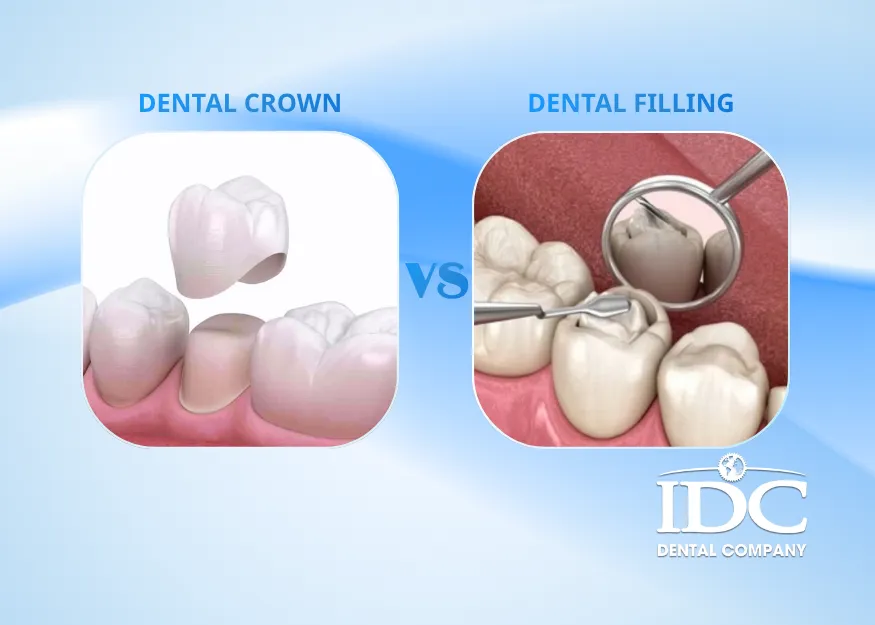
In this article, we’ll explore the key differences between dental crowns and fillings, including their benefits, limitations, lifespan, and the situations in which each treatment is recommended.
What Is a Dental Filling?
A dental filling is a restorative treatment used to repair small to moderate areas of tooth damage caused by decay, minor fractures, or wear.
During the procedure, the dentist removes the damaged tooth structure and fills the space with a restorative material. The filling restores the tooth’s shape and function while preventing bacteria from causing further decay.
How Dental Fillings Work
The process typically involves:
- Removing decayed tooth material
- Cleaning the cavity
- Applying the filling material
- Shaping and polishing the restoration
Most dental fillings can be completed in a single appointment.
Types of Dental Fillings
Composite Resin Fillings
Tooth-colored fillings that blend naturally with surrounding teeth.
Amalgam Fillings
Silver-colored fillings are known for their durability but are less commonly used today for cosmetic reasons.
Ceramic Fillings
Porcelain-based restorations offer excellent aesthetics and stain resistance.
Glass Ionomer Fillings
Often used for children or low-stress areas of the mouth.
What Is a Dental Crown?
A dental crown is a custom-made cap that completely covers a damaged tooth.
Unlike a filling, which repairs only part of a tooth, a crown protects the entire visible portion above the gum line.
Crowns are typically recommended when a tooth has lost significant structure and needs additional reinforcement.
How Dental Crowns Work
The procedure usually involves:
- Reshaping the tooth
- Taking digital or physical impressions
- Fabricating a custom crown
- Cementing the crown permanently
Crowns restore both function and appearance while protecting weakened teeth from future fractures.
Common Types of Dental Crowns
Porcelain Crowns
Natural-looking and ideal for front teeth.
Zirconia Crowns
Highly durable and suitable for both front and back teeth.
E-Max Crowns
Premium aesthetic crowns with excellent translucency.
Metal Crowns
Extremely strong but less attractive.
Porcelain-Fused-to-Metal (PFM) Crowns
Combine strength and aesthetics.
Dental Crown vs Dental Filling: What’s the Main Difference?
Although both treatments restore damaged teeth, they differ significantly in design and purpose.
Amount of Tooth Structure Covered
Dental Filling
A filling repairs only the damaged portion of the tooth.
Dental Crown
A crown covers the entire tooth, providing full protection.
This is one of the most important differences between the two treatments.
Treatment Purpose
Fillings
Used for minor to moderate damage.
Crowns
Used for severely weakened, fractured, or heavily restored teeth.
When a tooth can no longer support a filling safely, a crown is often recommended.
Strength and Protection
Fillings restore function but do not significantly strengthen weakened teeth.
Crowns, on the other hand, act like a protective helmet that surrounds the tooth and distributes biting forces more evenly.
As a result, crowns provide greater long-term protection.
Longevity
The average lifespan of fillings is generally shorter than that of crowns.
While fillings may last several years, crowns are designed for more extensive long-term protection.
When Do You Need a Dental Filling?
Dental fillings are often the preferred treatment when damage is limited and enough healthy tooth structure remains.
Small to Moderate Cavities
Early tooth decay can usually be treated successfully with a filling.
Minor Tooth Chips
Small fractures or chips may be repaired without the need for a crown.
Cosmetic Corrections
Composite fillings can improve the appearance of minor imperfections.
Preserving Natural Tooth Structure
When possible, dentists prefer conservative treatment approaches that preserve healthy enamel.
If the tooth remains structurally strong after removing decay, a filling is often sufficient.
When Do You Need a Dental Crown?
There are situations where a filling simply cannot provide enough support.
Large Cavities
When decay removes a significant portion of the tooth, a filling may not be strong enough.
Cracked or Fractured Teeth
Cracks can worsen over time if the tooth is not fully protected.
Root Canal-Treated Teeth
After root canal therapy, teeth often become more brittle and require reinforcement.
Severely Worn Teeth
Patients with grinding habits may lose substantial tooth structure over time.
Teeth with Large Existing Fillings
When a tooth already contains a large filling, replacing it with another filling may increase fracture risk.
Dental Implants
Implant restorations always require a crown rather than a filling.
How Dentists Decide Between a Crown and a Filling
Choosing the right treatment involves careful evaluation.
Amount of Remaining Tooth Structure
This is often the most important factor.
If more than half of the tooth is missing, a crown is frequently recommended.
Tooth Location
Front Teeth
Aesthetics often play a larger role.
Back Teeth
Strength and chewing forces become more important.
Molars generally experience greater stress and may require crowns more often.
Bite Force
Patients who grind their teeth place additional stress on restorations.
Crowns usually provide better long-term protection in these cases.
Risk of Future Fracture
If a tooth is at high risk of cracking, a crown may help prevent costly future treatment.
Pros and Cons of Dental Fillings
Advantages of Fillings
Less Invasive
Minimal removal of healthy tooth structure.
Lower Cost
Generally less expensive than crowns.
Faster Treatment
Often completed in one visit.
Preservation of Natural Tooth Structure
A conservative treatment option.
Disadvantages of Fillings
Less Durable for Large Cavities
Large fillings are more prone to failure.
Increased Fracture Risk
The remaining tooth structure may still be weak.
More Frequent Replacement
Fillings typically require replacement sooner than crowns.
Pros and Cons of Dental Crowns
Advantages of Crowns
Superior Protection
Crowns reinforce weakened teeth.
Long-Term Durability
They generally last longer than fillings.
Better for Severe Damage
Ideal for teeth that have lost significant structure.
Excellent Aesthetics
Modern ceramic crowns can closely mimic natural teeth.
Disadvantages of Crowns
Higher Cost
Crowns require additional materials and laboratory fabrication.
More Tooth Preparation
The tooth must be reshaped to accommodate the crown.
Longer Treatment Process
Some crowns require multiple appointments.
Dental Crown vs Filling Cost Comparison
Cost is often an important factor for patients.
Average Cost of Dental Fillings
The cost depends on:
- Filling material
- Size of the cavity
- Tooth location
Composite fillings are generally more expensive than amalgam fillings but offer superior aesthetics.
Average Cost of Dental Crowns
Crowns are usually more expensive because they involve:
- Custom fabrication
- Advanced materials
- Additional clinical time
Materials such as zirconia and E-Max crowns typically cost more than traditional restorations.
Long-Term Value
Although crowns cost more initially, they may reduce future treatment expenses by protecting weakened teeth from fractures.
Dental Crown vs Filling Lifespan
How Long Do Fillings Last?
Composite Fillings
Approximately 5–10 years.
Amalgam Fillings
Often 10–15 years or longer.
Ceramic Fillings
Typically 10–15 years.
How Long Do Crowns Last?
Porcelain Crowns
10–15 years.
Zirconia Crowns
15–20 years or longer.
E-Max Crowns
15–20 years.
Metal Crowns
20+ years.
Factors Affecting Longevity
- Oral hygiene
- Diet
- Teeth grinding
- Dental maintenance
- Bite forces
Proper care can significantly extend the lifespan of both restorations.
Can a Filling Be Replaced with a Crown?
Yes.
In fact, many crowns are placed on teeth that previously had fillings.
Signs a Filling Is No Longer Sufficient
- Recurrent decay
- Large fractures
- Cracked fillings
- Extensive wear
- Tooth weakness
When these problems occur, upgrading to a crown often provides a more predictable long-term solution.
Dental Crown vs Filling for Front Teeth
For front teeth, aesthetics are extremely important.
When a Filling May Be Enough
- Small cavities
- Minor chips
- Limited damage
When a Crown May Be Necessary
- Large fractures
- Extensive decay
- Significant discoloration
- Root canal-treated teeth
Modern porcelain and E-Max crowns provide excellent cosmetic results for front teeth.
Dental Crown vs Filling for Back Teeth
Molars are subjected to heavy chewing forces.
When Fillings Work Well
- Small to moderate cavities
- Minimal structural loss
When Crowns Are Preferred
- Large restorations
- Cracked molars
- Root canal-treated molars
- Severe wear
Crowns often provide superior durability in high-pressure chewing areas.
Comparison Table: Dental Crown vs Dental Filling
| Feature | Dental Filling | Dental Crown |
|---|---|---|
| Coverage | Partial Tooth | Entire Tooth |
| Strength | Moderate | Excellent |
| Durability | 5–10 Years | 10–20+ Years |
| Cost | Lower | Higher |
| Tooth Preparation | Minimal | More Extensive |
| Ideal For | Small Cavities | Severe Damage |
| Treatment Time | One Visit | One or Two Visits |
Frequently Asked Questions
Is a dental crown better than a filling?
Not necessarily. The best treatment depends on the amount of tooth damage and remaining tooth structure.
Can a cavity be treated with a filling instead of a crown?
Small and moderate cavities can often be treated with fillings.
Is a crown stronger than a filling?
Yes. Crowns provide significantly greater structural reinforcement.
Does a crown last longer than a filling?
In most cases, yes.
Can a filling turn into a crown later?
Absolutely. Many teeth initially restored with fillings eventually require crowns as damage progresses.


 WhatsApp