
How long does braces treatment take? For many patients, orthodontic treatment takes around 18 to 24 months, although simpler cases may finish sooner and complex cases can require 24 to 36 months or longer.
Treatment time depends on factors such as tooth alignment, bite problems, age, oral health, treatment method, and patient cooperation.
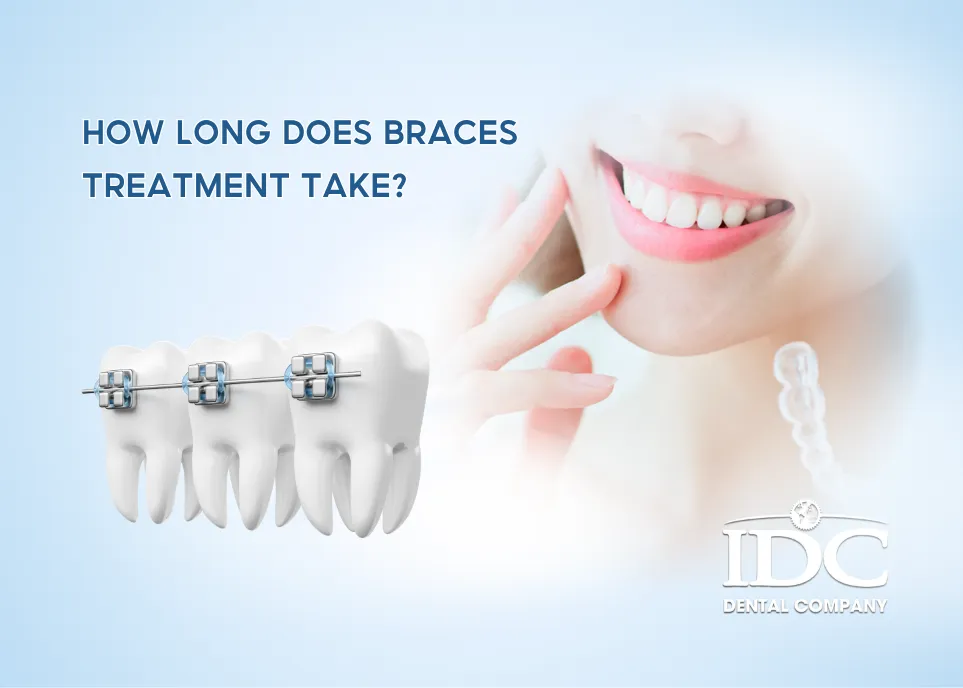
While there is no safe shortcut to dramatically speed up tooth movement, following your orthodontist’s instructions can help avoid unnecessary delays and keep treatment on schedule.
How long does braces treatment usually take?
The average treatment time for braces varies from patient to patient. A general estimate may look like this:
| Orthodontic condition | Approximate treatment time |
|---|---|
| Minor tooth movement | 6–12 months |
| Mild to moderate orthodontic problems | 12–18 months |
| Comprehensive orthodontic treatment | 18–24 months |
| Complex orthodontic cases | 24–36 months or longer |
These timeframes should only be considered general estimates.
A patient with minor spacing between several teeth may need significantly less treatment than someone with severe crowding and a complicated bite problem.
Even patients whose teeth look similar from the outside can require different treatment times. The orthodontist also needs to consider the position of the tooth roots, available space, jaw relationships, bone support, and how the upper and lower teeth fit together.
For this reason, an accurate estimate of braces treatment time can only be provided after an orthodontic examination.
What factors affect how long braces take?
Several factors determine how quickly orthodontic treatment can progress.
Severity of Tooth Misalignment
One of the most important factors is how far the teeth need to move.
Minor rotations, small gaps, or mild crowding may be relatively straightforward to correct. Severe crowding or significant protrusion can require more extensive movement.
If there is insufficient room to align the teeth properly, additional space may need to be created. Depending on the case, this may involve different orthodontic techniques or, in some patients, tooth extraction.
The greater the amount and complexity of tooth movement required, the longer treatment may take.
Type of Bite Problem
Straightening the visible teeth is only one part of orthodontics.
The orthodontist also considers how the upper and lower teeth fit together. Problems may include:
- Overbite
- Underbite
- Crossbite
- Open bite
- Deep bite
- Crowding
- Excessive spacing
Correcting a complex bite can take considerably longer than simply aligning several crooked front teeth.
This is also why your teeth may look straight before your braces are ready to come off.
Age
Orthodontic treatment can be successful in children, teenagers, and adults.
Children and adolescents may sometimes benefit from ongoing jaw development, depending on their orthodontic condition and timing of treatment.
Adults can also have their teeth moved successfully. However, adult patients are more likely to have additional dental considerations such as missing teeth, crowns, bridges, gum recession, periodontal disease, or reduced bone support.
Therefore, age can influence treatment planning, but being an adult does not automatically mean braces will take much longer.
Jaw and Bone Structure
Some orthodontic problems primarily involve tooth position, while others are related to the size or position of the jaws.
For example, an underbite may result mainly from the teeth or may involve a significant skeletal discrepancy.
Skeletal problems can require a different and sometimes more complex treatment approach than dental alignment alone.
Oral Health
Healthy teeth and gums provide an important foundation for orthodontic treatment.
Patients with active cavities, significant gingivitis, or periodontal disease may need treatment before orthodontic tooth movement begins.
Oral health problems that develop during braces can also interrupt treatment.
Maintaining healthy teeth and gums therefore helps reduce avoidable delays.
How Long Do Braces Take for Crooked or Crowded Teeth?
Mildly crooked teeth may begin to improve relatively quickly during the initial alignment stage.
With more severe crowding, however, the orthodontist first needs to determine how enough space can be created to correctly position all the teeth.
This may involve moving several teeth simultaneously, expanding or modifying the available dental arch space when appropriate, reducing small amounts of enamel between selected teeth, or extracting teeth in certain cases.
Once the visible crowns of the teeth become straighter, additional treatment may still be necessary to position the roots and correct the bite.
Therefore, the time required depends on how crowded the teeth are and how much movement is necessary, rather than simply whether the teeth appear crooked.
How long do braces take to close gaps?
Small gaps between teeth may sometimes begin closing within the first few months of orthodontic treatment.
However, the orthodontist also needs to determine why the spaces exist.
Spacing may be associated with:
- Tooth size
- Missing teeth
- Tooth position
- Jaw size
- Soft-tissue factors
- Previous tooth loss
Simply closing a visible gap does not necessarily complete treatment.
The roots of the teeth must also be appropriately positioned, and the bite needs to remain functional and stable.
How long do braces take to correct an overbite?
The answer depends on the cause and severity of the overbite.
A relatively mild dental overbite may be easier to correct, while significant protrusion or a complex relationship between the upper and lower jaws can require more extensive treatment.
Some patients may need orthodontic elastics or other appliances to help improve the relationship between the upper and lower teeth.
If considerable space is required to retract protruding teeth, tooth extraction may also be considered in selected cases.
As a result, overbite correction may continue even after the front teeth appear relatively straight.
How long do braces take for an underbite?
An underbite can be primarily dental, skeletal, or a combination of both.
When the problem is mainly related to tooth position, orthodontic treatment may be able to improve the bite in suitable cases.
A significant skeletal underbite is more complex and may require a different treatment approach.
Therefore, it is difficult to estimate treatment time based only on the appearance of an underbite. A detailed examination of the teeth and jaws is necessary.
What Are the Main Stages of Braces Treatment?
Understanding the different stages of orthodontic treatment makes it easier to understand why braces often take many months.
Stage 1: Orthodontic Examination and Treatment Planning
Before braces are placed, the orthodontist evaluates your teeth, bite, gums, and jaw relationships.
Diagnostic records may include:
- Dental X-rays
- Photographs
- Digital scans or impressions
- Bite analysis
This information is used to develop an individualized treatment plan.
Stage 2: Preparing the Teeth
Some patients need dental treatment before braces.
This can include treating cavities, improving gum health, professional cleaning, or extracting teeth when indicated as part of the orthodontic plan.
Stage 3: Alignment and Leveling
During the initial phase of braces treatment, archwires gradually guide crooked and rotated teeth into better alignment.
This is often when patients notice the most obvious early changes.
Stage 4: Space Closure and Bite Correction
After initial alignment, treatment may focus on closing remaining spaces and improving the relationship between the upper and lower teeth.
Orthodontic elastics or other mechanics may be used during this stage.
Stage 5: Finishing and Detailing
Once the major tooth movements have been achieved, smaller adjustments may be necessary.
The orthodontist may refine:
- Individual tooth positions
- Tooth contacts
- Dental midlines
- Root positions
- Bite relationships
These final adjustments are one reason braces may remain in place even though the smile already looks straight.
Stage 6: Braces Removal and Retention
Once the treatment goals have been achieved, the braces are removed.
The next stage is retention, which is essential for maintaining the result.
How Soon Will You See Results From Braces?
Many patients notice some changes within the first few weeks to several months.
Front teeth that were visibly crooked may begin to look straighter relatively early in treatment.
However, the speed of visible improvement varies significantly.
It is also important to understand that visible improvement does not mean orthodontic treatment is complete.
The teeth may look straight while the orthodontist is still working on root position, spaces, bite relationships, or other details.
This is why braces should not be removed simply because your smile already looks good in the mirror.
Do braces take longer if you need teeth extracted?
Not necessarily.
Orthodontic extractions may be recommended when additional space is required to address significant crowding, protrusion, or certain bite problems.
After extraction, the spaces are deliberately used as part of the orthodontic plan. Teeth may need to move into those spaces, and their roots must also be carefully controlled.
This process takes time.
However, it would be inaccurate to say that every extraction case takes longer than every non-extraction case.
A complex non-extraction case may require significantly more time than a straightforward extraction case.
The decision to extract teeth should therefore be based on diagnosis and treatment goals rather than an attempt to shorten treatment.
Are clear aligners faster than traditional braces?
Clear aligners can be an excellent orthodontic option, but they are not automatically faster than braces.
Both clear aligners and traditional braces can move teeth effectively when used for appropriate cases.
Traditional braces remain attached to the teeth, so the orthodontic system continues to work without the patient needing to remember to put it back on.
Clear aligners are removable. This provides advantages for eating, cleaning, and appearance, but also makes patient compliance particularly important.
If aligners are not worn as directed, teeth may not move according to the planned sequence. This can lead to additional aligners or an extended treatment time.
The best option depends on:
- Type of tooth movement required
- Severity of the bite problem
- Patient preferences
- Oral health
- Ability to follow treatment instructions
Neither system should be selected solely because it is advertised as faster.
Can you make braces work faster?
There is no safe way to simply force teeth to move dramatically faster.
However, you can take several steps to prevent unnecessary delays and help your braces stay on schedule.
Attend Every Orthodontic Appointment
Regular appointments allow your orthodontist to monitor progress and make the necessary adjustments.
Repeatedly postponing or missing appointments can slow treatment because the next stage may not begin when planned.
Wear Orthodontic Elastics as Directed
Elastics are often used to help correct bite relationships.
If you have been instructed to wear them, consistency is important.
Wearing elastics only occasionally may reduce their effectiveness and potentially extend treatment.
Do not use extra elastics in an attempt to speed up treatment unless specifically instructed by your orthodontist.
Take Care of Your Brackets and Wires
Broken brackets and damaged wires can interrupt planned tooth movement.
Patients with braces are often advised to be careful with very hard, sticky, or chewy foods that may damage orthodontic appliances.
If a bracket breaks, contact your dental or orthodontic office for advice rather than waiting several weeks for your next appointment.
Maintain Good Oral Hygiene
Braces create additional areas where food and plaque can collect.
Poor oral hygiene can lead to:
- Gingivitis
- Cavities
- Enamel demineralization
- Other dental problems
If significant dental disease develops, orthodontic treatment may need to be modified while the problem is managed.
Careful brushing, interdental cleaning, and regular professional dental care can help keep treatment progressing smoothly.
Follow Instructions Carefully
The orthodontic treatment plan is designed around specific movements.
Follow instructions regarding elastics, appliances, aligners, oral hygiene, and appointments.
Trying to modify your braces or use online “braces hacks” without professional supervision can interfere with the treatment plan.
Does tightening braces more make teeth move faster?
No. More force does not automatically mean faster orthodontic treatment.
To understand why, it helps to understand how teeth move.
A tooth is supported by surrounding bone and the periodontal ligament. When controlled orthodontic force is applied, biological changes occur in these supporting tissues. Bone is gradually remodeled, allowing the tooth to move.
This process requires time.
Applying excessive force does not simply make the biological process happen twice as fast.
Orthodontic treatment therefore focuses on applying appropriate, controlled forces, rather than the strongest possible force.
This is also why attempting to tighten orthodontic appliances yourself is not an appropriate way to shorten treatment.
What can make braces treatment take longer?
Several factors can delay orthodontic progress.
Common examples include:
- Frequently missing appointments
- Repeatedly breaking brackets
- Damaging orthodontic wires
- Not wearing elastics as instructed
- Poor compliance with clear aligners
- Losing aligners
- Developing cavities
- Gum inflammation or periodontal problems
- Poor oral hygiene
- Unexpected tooth movement
- Complex bite correction
- Changes to the original treatment plan
Not all delays can be prevented. Teeth do not respond identically in every person, and sometimes treatment needs to be modified based on how an individual responds.
However, good patient cooperation can reduce many avoidable delays.
Do braces take longer for adults?
Adults can successfully undergo orthodontic treatment at many ages.
Being 30, 40, or older does not automatically make you unsuitable for braces.
However, adult patients are more likely to have existing dental conditions that need to be considered, such as:
- Missing teeth
- Dental crowns
- Bridges
- Dental implants
- Gum recession
- Periodontal disease
- Bone loss
- Previous root canal treatment
The condition of the gums and supporting bone is particularly important.
An adult with healthy periodontal tissues and a relatively straightforward orthodontic problem may potentially have a simpler treatment course than a younger patient with a severe bite discrepancy.
Therefore, case complexity and oral health can be more important than age alone when estimating treatment time.
How long do braces take after age 30?
There is no special braces timeline that applies to everyone over 30.
Many adults may still require approximately 18 to 24 months for comprehensive treatment, while others may need considerably less or more time.
Before beginning adult orthodontics, the dental team may evaluate:
- Periodontal health
- Bone support
- Missing teeth
- Existing restorations
- Previous dental treatment
- Bite relationships
- Tooth mobility
- Overall treatment goals
A personalized assessment is the best way to determine whether braces are appropriate and how long treatment may take.
Can braces really work in 6 months or one year?
Some orthodontic cases can be completed relatively quickly.
For example, a patient with minor alignment problems and a generally acceptable bite may require considerably less time than someone who needs comprehensive bite correction.
However, patients should understand the difference between limited cosmetic alignment and comprehensive orthodontic treatment.
Making several visible front teeth appear straighter may sometimes be achieved relatively quickly. Correcting crowding throughout the mouth, positioning roots, managing protrusion, closing spaces, and improving the bite may require substantially more time.
Therefore, advertisements promising “6-month braces” should not be interpreted as a universal treatment time.
A realistic timeline should be determined after an orthodontic assessment.
How long do you need to wear a retainer after braces?
Your orthodontic journey does not completely end when your braces come off.
Teeth naturally have a tendency to move after orthodontic treatment. This is known as orthodontic relapse.
Retainers are designed to help maintain the corrected positions of the teeth.
There are different types of retainers, including removable and fixed options. Your orthodontist may recommend more frequent wear initially and nighttime wear later.
For many patients, some form of long-term retention is recommended because teeth can continue to shift throughout life.
Following retainer instructions is therefore important for protecting the result you spent months or years achieving.
Frequently asked questions about braces treatment time
How long do braces usually take?
Many comprehensive orthodontic treatments take around 18–24 months, although individual treatment times vary considerably.
Can braces work in six months?
Some minor orthodontic problems may be treated within a relatively short period, but six months is not sufficient for every patient.
Can braces straighten teeth in one year?
Yes, some patients may complete treatment within approximately one year. More complicated cases generally require longer.
Is two years with braces normal?
Yes. Approximately two years is a common timeframe for comprehensive orthodontic treatment.
Can braces take more than three years?
Yes. Complex orthodontic conditions, treatment interruptions, or poor compliance can result in treatment lasting three years or longer.
How long until you notice braces working?
Some patients notice visible changes within several weeks to a few months, although this varies.
Do broken brackets make treatment longer?
Occasional breakage that is repaired promptly may have little impact. Repeated breakages can interfere with planned tooth movement and potentially extend treatment.
Can you speed up braces by using stronger elastics?
You should only use the elastics prescribed by your orthodontist. Using additional or stronger elastics without professional guidance is not an appropriate way to accelerate treatment.
How can you find out how long your braces will take?
So, how long does braces treatment take? For many patients, comprehensive orthodontic treatment lasts approximately 18 to 24 months. Relatively simple cases may take less time, while complex cases involving severe crowding, significant bite problems, extractions, or extensive tooth movement may require 24 to 36 months or longer.
Treatment time depends on many factors, including the severity of tooth misalignment, type of malocclusion, jaw structure, periodontal health, age, treatment method, biological response, and patient cooperation.
There is no safe shortcut that can make every case finish dramatically faster. Instead, the best approach is to focus on keeping treatment efficient and on schedule: attend appointments, wear elastics or aligners as directed, protect your orthodontic appliances, maintain excellent oral hygiene, and follow your orthodontist’s instructions.
Most importantly, successful orthodontic treatment should not be judged solely by how quickly the braces come off. The goal is to achieve properly aligned teeth, a functional bite, healthy supporting tissues, and a stable result that can be maintained over the long term.
If you are considering braces, an orthodontic examination is the most reliable way to determine how long your braces treatment may take and whether traditional braces, ceramic braces, or clear aligners are appropriate for your individual needs.

 WhatsApp