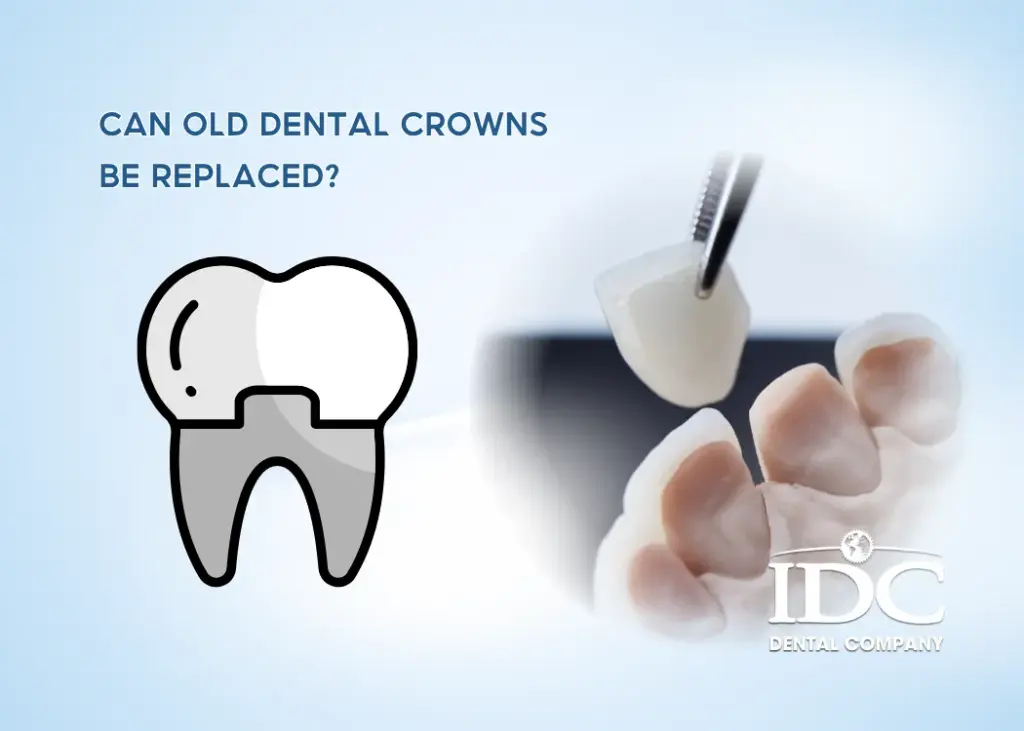
Can old dental crowns be replaced? Yes. An old dental crown can usually be removed and replaced with a new one when it becomes cracked, loose, worn, poorly fitting, or when problems such as tooth decay develop underneath it. A crown may also be replaced when its color, shape, or appearance no longer meets the patient’s aesthetic expectations.
However, having an old crown does not automatically mean you need a new one. A crown that has been in place for many years may still function well if it remains secure, fits properly, the surrounding gums are healthy, and the natural tooth underneath has no signs of disease.
The decision to replace an old dental crown should therefore be based on its condition rather than its age alone. A dental examination, and sometimes X-rays, can help determine whether the crown can continue to be used or should be replaced.
How Long Do Dental Crowns Last?
Dental crowns are designed to provide long-term protection and restore the shape and function of damaged teeth, but they are not expected to last forever.
The lifespan of a dental crown can vary significantly from one person to another. Several factors can influence how long a crown remains functional, including:
- Crown material
- Location of the tooth
- Condition of the natural tooth underneath
- Quality and fit of the restoration
- Oral hygiene
- Bite forces
- Teeth grinding or clenching
- Dietary habits
- Gum health
- Regular dental care
A crown on a front tooth, for example, may experience different forces than a crown on a molar. Similarly, someone who frequently grinds their teeth may place considerably more stress on a restoration.
For these reasons, it is better to evaluate how well the crown is functioning rather than deciding that it must be replaced after a specific number of years.
Does a 10-Year-Old Crown Need to Be Replaced?
Not necessarily.
Patients sometimes assume that dental crowns should automatically be replaced after 10 years. In reality, there is no universal expiration date for a crown.
If a 10-year-old crown remains secure, the margins are intact, the tooth is comfortable, the gums are healthy, and there is no evidence of decay underneath it, there may be no immediate reason to replace it.
On the other hand, a much newer crown could require replacement if it becomes fractured, loose, or develops problems underneath.
Can a 15- or 20-Year-Old Crown Still Be Good?
Yes. Some older crowns may continue to function satisfactorily for many years.
A dentist will usually consider factors such as:
- Whether the crown is still firmly attached
- Whether its margins remain sealed
- Whether there is recurrent decay
- Whether the crown is cracked or significantly worn
- Whether the gums around it are healthy
- Whether the bite remains stable
Therefore, the number of years a crown has been in the mouth is only one part of the evaluation.
When Should an Old Dental Crown Be Replaced?
Several signs may indicate that an old crown should be evaluated for possible replacement.
1. The Crown Is Cracked or Broken
Dental crowns are made from durable materials, but they can still become damaged.
Possible causes include:
- Biting very hard foods or objects
- Dental trauma
- Teeth grinding
- Clenching
- Excessive bite forces
- Long-term wear
A very small surface chip may sometimes be polished or repaired depending on the material and location. However, a significant crack or fracture can compromise the strength or fit of the crown.
In these situations, replacing the restoration may be necessary.
2. The Dental Crown Is Loose
A properly fitted crown should feel stable.
If your crown moves when you chew or touch it with your tongue, it should be examined by a dentist.
A loose crown can be associated with:
- Breakdown of the dental cement
- Tooth decay underneath the crown
- Damage to the supporting tooth
- Changes in crown fit
- Fracture of the crown or tooth
It is important to distinguish between a loose crown and a loose natural tooth. These are different conditions and require different treatments.
Avoid trying to permanently glue a loose crown back into place yourself. The underlying tooth should first be examined.
3. There Is a Gap Around the Crown
The area where the crown meets the natural tooth is known as the crown margin. Ideally, this area should fit precisely and be easy to keep clean.
If a gap develops, you may notice:
- Food frequently becoming trapped
- Difficulty flossing
- An unpleasant taste or odor
- Gum irritation
- Visible changes around the crown margin
Plaque and bacteria can accumulate around poorly fitting margins, increasing the risk of gum inflammation and recurrent tooth decay.
If the crown no longer fits properly, replacement may be recommended.
4. Tooth Decay Has Developed Under the Crown
A common misconception is that once a tooth has been crowned, it can no longer develop cavities.
This is not true.
A dental crown covers the prepared portion of the tooth, but natural tooth structure remains underneath. Decay can still develop, particularly around the area where the crown meets the tooth.
If bacteria penetrate this area, recurrent decay may gradually damage the supporting tooth.
Treatment may involve:
Removing the old crown → removing the decay → assessing the remaining tooth → rebuilding the tooth if necessary → placing a new crown.
If the decay has reached the pulp or caused more extensive damage, additional treatment may be required before a new crown can be placed.
5. The Crowned Tooth Hurts
A tooth with an old crown should not normally develop persistent pain without a reason.
Symptoms that should be evaluated include:
- Pain when biting
- Pain while chewing
- Sensitivity to hot or cold
- Persistent aching
- Throbbing pain
- Tender or swollen gums
Importantly, replacing the crown itself may not necessarily solve the problem.
Pain could originate from the natural tooth, pulp, root, surrounding bone, periodontal tissues, or even the bite. The underlying cause should therefore be diagnosed before treatment is performed.
6. The Gums Around the Crown Are Inflamed
Healthy gums should generally fit closely around the tooth without persistent swelling or bleeding.
If you regularly experience:
- Red gums
- Swelling
- Bleeding while brushing or flossing
- Tenderness
- Persistent bad breath around the crown
the area should be examined.
Sometimes the problem is related primarily to plaque accumulation and can improve with professional cleaning and better oral hygiene.
In other situations, the crown itself may have an inappropriate contour or margin that makes the area difficult to clean. If the restoration contributes to persistent gum problems, replacement may be considered.
7. Gum Recession Has Exposed the Crown Margin
Gum position can change over time.
When the gums recede, part of the natural tooth or crown margin may become visible. This can cause:
- Tooth sensitivity
- A visible line around the crown
- A longer-looking tooth
- An uneven gumline
- Cosmetic concerns
Not every case of gum recession requires crown replacement. The cause and severity of the recession should first be evaluated.
8. There Is a Dark Line Around the Crown
A dark line around an older crown can have several explanations.
For example, gum recession may expose the edge of a restoration. Certain older crowns containing a metal substructure may also show a darker margin as the gumline changes.
A dark line is therefore not automatically evidence that the tooth is decayed or infected.
However, if the appearance bothers you or there are additional problems with the crown, replacement with a different type of restoration may be considered.
9. The Old Crown No Longer Looks Natural
Dental crowns may also be replaced for cosmetic reasons.
You may want to consider replacement if:
- The crown no longer matches neighboring teeth
- The crown appears too white or opaque
- The tooth looks too large or bulky
- The shape does not complement your smile
- The gumline has changed
- Newer dental restorations no longer match the older crown
For front teeth especially, crown shape, translucency, proportion, surface texture, and color can all influence the appearance of the smile.
Before replacing a clinically healthy crown solely for cosmetic reasons, however, the benefits should be weighed against the need to perform additional treatment on the tooth.
When Does an Old Crown Not Need to Be Replaced?
Not every old dental crown needs to be removed.
A crown may continue to function if:
- It remains securely attached
- There are no significant cracks
- The margins remain acceptable
- There is no decay underneath
- The tooth does not hurt
- The gums are healthy
- The bite is comfortable
- Its appearance remains acceptable
This is why routine dental examinations are valuable. A dentist can monitor an older restoration and recommend replacement when there is a clinical reason rather than simply because a certain number of years have passed.
How Does a Dentist Know Whether a Crown Needs Replacement?
A dentist may use several methods to evaluate an old crown.
Visual and Clinical Examination
The dentist can examine the crown for cracks, wear, marginal gaps, gum inflammation, food trapping, and other visible abnormalities.
Bite Evaluation
The way the upper and lower teeth come together can influence the lifespan of a crown. Excessive pressure on one restoration may contribute to wear or fracture.
Dental X-Rays
When indicated, X-rays may help identify problems that cannot be seen directly, including decay, changes around the root or bone, and certain problems involving previously treated teeth.
Gum and Periodontal Evaluation
The dentist may also examine the tissues surrounding the crowned tooth for inflammation, recession, periodontal pockets, or loss of support.
Together, these findings help determine whether the crown can be monitored, repaired, or replaced.
How Are Old Dental Crowns Removed?
When a crown needs replacement, the dentist first evaluates the restoration and the tooth underneath as much as possible.
The crown may then be carefully sectioned with dental instruments. Rather than pulling aggressively on the tooth, the crown can be divided into sections and removed in pieces when appropriate.
The goal is to remove the old restoration while preserving as much healthy natural tooth structure as possible.
After the crown is removed, the underlying tooth becomes accessible for a more complete examination.
Does Removing an Old Crown Hurt?
Removing an old dental crown should generally be performed with patient comfort in mind. Local anesthesia can be used when appropriate.
The experience can vary depending on:
- Whether the tooth is vital
- Existing sensitivity
- Tooth decay
- Inflammation
- Condition of the crown
- Complexity of removal
If the tooth is already painful or sensitive, let your dentist know before treatment begins.
Does the Tooth Need to Be Shaved Again When Replacing a Crown?
Not necessarily.
When the old crown is removed, the dentist evaluates the existing tooth preparation.
If the underlying tooth remains healthy and its shape is suitable for the new restoration, only minor adjustments may be necessary.
However, additional treatment may be required if:
- Decay needs to be removed
- Part of the tooth has fractured
- The old preparation is unsuitable
- The tooth requires rebuilding
- The new restoration requires modification of the existing preparation
The objective should be to preserve as much healthy tooth structure as reasonably possible.
What Happens to the Natural Tooth Under an Old Crown?
The condition underneath an old crown can vary significantly.
After removal, the dentist may find:
- Healthy tooth structure
- Recurrent tooth decay
- A crack or fracture
- An old filling or core buildup
- Insufficient remaining tooth structure
- A previously root canal-treated tooth
- Problems involving the pulp or root
This is one reason it is difficult to determine the entire treatment plan simply by looking at the crown from the outside.
The health and amount of remaining natural tooth structure ultimately influence whether another crown can be placed.
Can a Crown Be Replaced If the Tooth Underneath Is Decayed?
In many cases, yes, provided enough healthy tooth structure remains to support a new restoration.
Treatment may involve:
- Removing the old crown.
- Removing the decayed tooth structure.
- Evaluating the remaining tooth.
- Rebuilding the tooth if necessary.
- Performing root canal treatment if clinically indicated.
- Preparing the tooth for the new restoration.
- Fabricating and placing the new crown.
If decay extends too deeply or too little healthy tooth structure remains, another treatment approach may be necessary.
For this reason, treating recurrent decay early can sometimes help preserve more of the natural tooth.
Can You Replace a Crown on a Root Canal Tooth?
Yes. A crown on a root canal-treated tooth can be replaced.
Before doing so, the dentist may evaluate:
- The quality and condition of the existing root canal treatment
- Remaining natural tooth structure
- Any signs of fracture
- The supporting bone
- The existing core or post if present
- Symptoms or signs of infection
Dental X-rays may be recommended as part of this assessment.
If the underlying tooth and root canal treatment remain satisfactory, a new crown may be fabricated. If a problem is detected, additional treatment may be necessary first.
Can an Old Crown Be Removed and Reused?
If a crown is intentionally being replaced because it is damaged or no longer fits properly, it usually will not be reused.
There are several reasons for this.
The crown may need to be cut into sections during removal. More importantly, if the tooth underneath needs treatment or reshaping, the old restoration may no longer fit the tooth correctly.
This situation is different from a relatively intact crown that has simply become dislodged. In selected cases, a dentist may determine whether such a crown can be re-cemented.
What Type of Crown Should Replace an Old Crown?
There is no single crown material that is best for every tooth.
The choice depends on factors such as:
- Location of the tooth
- Remaining natural tooth structure
- Bite forces
- Teeth grinding
- Gum position
- Aesthetic expectations
- Available space
- Condition of surrounding teeth
Zirconia Crowns
Zirconia is commonly considered when strength and durability are important. Different types of zirconia also provide varying levels of translucency and aesthetics.
All-Ceramic Crowns
Ceramic restorations can provide natural-looking color and translucency and may be considered particularly when aesthetics are a priority.
However, material alone does not determine the success of a crown.
Proper diagnosis, tooth preparation, crown design, marginal fit, bite adjustment, oral hygiene, and long-term maintenance are all important.
How Long Does Dental Crown Replacement Take?
The treatment time depends on the individual case.
Replacing an old crown may be relatively straightforward when the underlying tooth is healthy.
Treatment can take longer if the dentist discovers:
- Significant tooth decay
- Gum inflammation
- Root canal problems
- A fractured tooth
- Insufficient tooth structure
- Periodontal disease
The number of crowns being replaced and the laboratory or digital workflow used to fabricate the restorations can also influence the timeline.
How Much Does It Cost to Replace an Old Dental Crown?
The cost of dental crown replacement varies depending on several factors, including:
- Type of crown material
- Number of teeth
- Location of the tooth
- Complexity of treatment
- Condition of the underlying tooth
- Need for core buildup
- Root canal treatment if necessary
- Gum or periodontal treatment if required
For this reason, an accurate cost estimate usually requires an examination.
The first question should not simply be “How much is a new crown?” but rather “Why does this crown need replacement, and what condition is the tooth underneath in?”
Can Multiple Old Crowns Be Replaced at the Same Time?
Yes, multiple crowns can be replaced as part of the same treatment plan when appropriate.
This may be considered for patients who have several aging restorations or older cosmetic dental work.
However, each tooth should still be evaluated individually.
For example, if a patient has eight older front crowns, it does not necessarily mean all eight must be replaced because one has developed a problem.
When several crowns are being replaced for aesthetic reasons, the dentist may also consider:
- Tooth proportions
- Smile line
- Crown length and width
- Gum symmetry
- Color
- Translucency
- Bite
- Relationship between the teeth and facial features
This allows the new restorations to function as part of the overall smile rather than as individual crowns.
How Can You Make a New Dental Crown Last Longer?
Good maintenance can help protect both the crown and the natural tooth underneath.
Important habits include:
- Brush your teeth at least twice daily.
- Clean between the teeth every day.
- Pay particular attention to crown margins.
- Maintain healthy gums.
- Attend regular dental examinations.
- Avoid chewing ice or extremely hard objects.
- Do not use crowned teeth to open packaging.
- Address teeth grinding or clenching.
- Wear a night guard if prescribed by your dentist.
Remember that although the crown itself cannot develop a cavity, the natural tooth around and underneath it still can.
Good oral hygiene around the crown margin is therefore essential.
What Happens If You Don’t Replace a Bad Dental Crown?
The consequences depend on why the crown is failing.
For example, leaving a poorly fitting crown untreated may contribute to continued food trapping and plaque accumulation. If decay is already present underneath, it may progress and destroy additional tooth structure.
A cracked crown may become more extensively damaged, while an untreated problem involving the natural tooth could eventually cause pain or infection.
Possible consequences include:
- Gum inflammation
- Increasing tooth decay
- Tooth sensitivity
- Pain when chewing
- Crown fracture
- Loss of additional tooth structure
- Infection in some cases
However, this does not mean that every old crown should be replaced preventively. A healthy, functional crown can often simply be monitored during routine dental visits.
Frequently Asked Questions About Replacing Old Dental Crowns
Can old dental crowns be replaced?
Yes. Old crowns can usually be removed and replaced when there is a clinical or aesthetic reason to do so. The underlying tooth should first be evaluated to determine whether it is healthy enough to support another restoration.
How often should dental crowns be replaced?
There is no universal replacement schedule. Crowns should be evaluated based on their fit, structural condition, surrounding gums, underlying tooth, bite, and appearance rather than being automatically replaced after a fixed number of years.
Can a crowned tooth still get a cavity?
Yes. Natural tooth structure remains underneath the crown, and decay can develop around the crown margin. Good oral hygiene and regular dental examinations remain important after crown placement.
Why does my old crown smell bad?
An odor around a crown may be associated with trapped food, plaque accumulation, gum inflammation, or problems with the crown margin. Bad breath can also have other oral and non-dental causes, so an examination is needed to identify the source.
Can a crown be replaced without damaging the tooth?
Dentists generally aim to remove the existing crown while preserving as much healthy tooth structure as possible. However, the condition of the tooth underneath and the method required to remove the restoration can vary.
Can I replace just one crown among several front crowns?
Potentially, yes. The new crown needs to be matched carefully to the neighboring restorations in terms of color, shape, translucency, and proportion. In some situations, achieving an exact aesthetic match may be challenging, so the options should be discussed before treatment.
What if there isn’t enough tooth left for another crown?
The dentist will assess whether the tooth can be rebuilt or whether additional procedures may help create sufficient support. If the tooth cannot be predictably restored, alternative treatment options may need to be considered.
When Should You See a Dentist About an Old Crown?
You should consider having an old crown examined if you notice:
pain, sensitivity, a loose crown, cracking or chipping, food repeatedly getting trapped around the crown, persistent odor, swollen or bleeding gums, an exposed crown margin, or changes in your bite.
You do not need to wait until a crowned tooth becomes severely painful.
Regular dental examinations can sometimes identify problems around older restorations before significant symptoms develop, potentially allowing more conservative treatment.


 WhatsApp