
Can teeth shift again after braces? Yes. Teeth can move after braces or clear aligner treatment, especially when retainers are not worn as recommended. This movement is often referred to as orthodontic relapse. After orthodontic treatment, the bone and tissues surrounding the teeth need time to adapt to their new positions, and teeth can also continue to change naturally throughout life.
This does not necessarily mean that your orthodontic treatment has failed. Minor changes in tooth position can occur over time. However, noticeable crowding, reopened gaps, rotated teeth, or changes in your bite should be evaluated by a dentist or orthodontist.
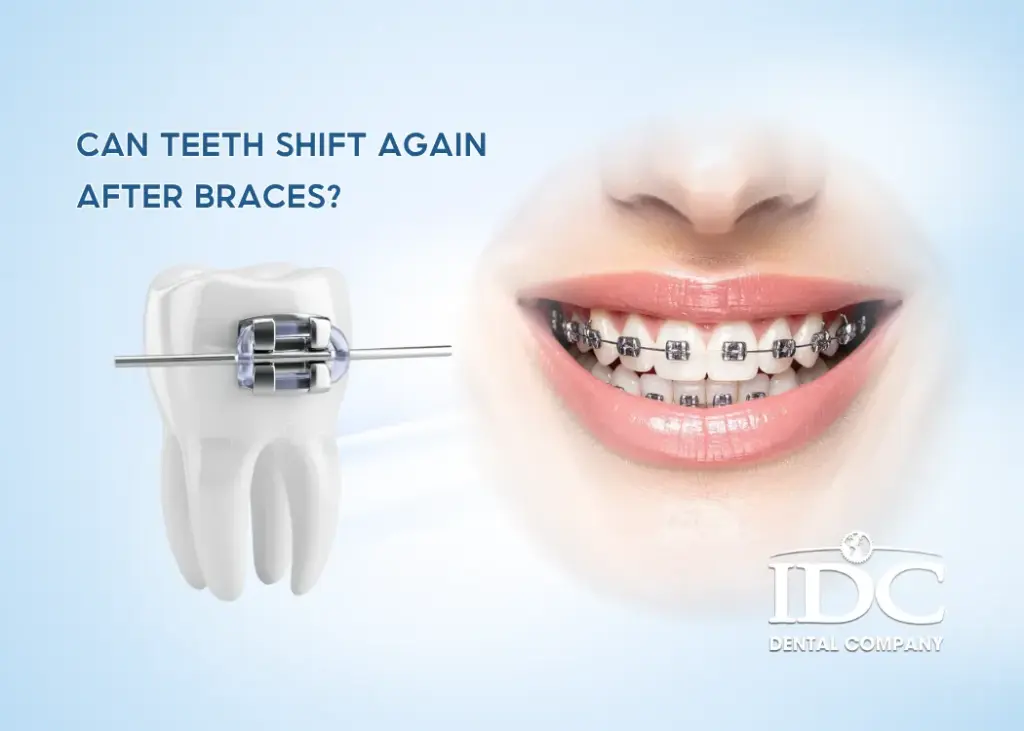
One of the most important ways to maintain your new smile is to wear your retainer as directed after braces and have it checked if it becomes loose, damaged, or no longer fits properly.
Why Do Teeth Shift After Braces?
Braces and clear aligners work by applying controlled forces to the teeth. These forces gradually move teeth through the surrounding bone into improved positions.
As teeth move, the bone and supporting tissues undergo remodeling. When active orthodontic treatment ends, this biological process does not immediately stop.
A simplified way to understand the process is:
Braces move the teeth → bone remodels → braces are removed → surrounding tissues continue adapting → retainers help maintain the new positions.
Several factors can contribute to teeth moving again after treatment.
1. Not Wearing Your Retainer
One of the most common reasons for teeth shifting after braces is inadequate retainer wear.
Some patients assume that once the braces come off and their teeth look straight, orthodontic treatment is completely finished. However, retention is an important part of maintaining the result.
Problems may occur when you:
- Stop wearing your retainer too early
- Frequently forget to wear it
- Wear it less often than recommended
- Lose your retainer and do not replace it
- Stop using it because your teeth still appear straight
Without adequate retention, teeth may gradually move away from their corrected positions.
The risk can be particularly important during the period following active orthodontic treatment, while the surrounding tissues are still adapting.
2. Bone and Tissues Are Still Adapting
Teeth are held within the jawbone by complex supporting structures, including the periodontal ligament and surrounding alveolar bone.
During orthodontic treatment, these structures undergo changes that allow teeth to move.
Once braces are removed, the teeth may be in their intended positions, but the supporting tissues still require time to reorganize. During this period, there can be a tendency for some teeth to move.
This is one of the main reasons retainers are prescribed after braces.
3. Teeth Naturally Change With Age
Even people who have never worn braces may experience changes in tooth position as they get older.
The dental arches and bite are not completely static throughout life. Some people notice:
- Increasing crowding of the lower front teeth
- Minor rotations
- Changes in spacing
- Changes in the way the upper and lower teeth meet
Therefore, movement years after braces is not always caused by a problem with the original orthodontic treatment.
Natural age-related changes are also one reason long-term retention may be recommended.
4. Your Retainer No Longer Fits Properly
A retainer can only work effectively if it continues to fit correctly.
Over time, removable retainers can:
- Crack
- Become distorted
- Wear down
- Become loose
- Warp after exposure to heat
- Stop fitting because the teeth have already moved
A retainer that once fit comfortably but suddenly feels tight can be an early indication that tooth positions have changed.
If your retainer no longer fits properly, do not ignore the problem for months. Have it checked so the cause can be identified.
5. Persistent Oral Habits
Certain habits can repeatedly place pressure on the teeth and potentially influence their position.
Examples include:
- Tongue thrusting
- Thumb sucking
- Persistent lip biting
- Other oral habits that place prolonged forces on teeth
The effect depends on the type, duration, and intensity of the force.
If an oral habit contributed to the original orthodontic problem and continues after treatment, it may need to be addressed as part of long-term retention.
6. Teeth Grinding and Clenching
Bruxism involves grinding or clenching the teeth, often unconsciously.
These forces can contribute to tooth wear and affect the bite. They may also damage certain types of retainers.
However, teeth grinding does not automatically mean that your teeth will relapse after braces. Its impact depends on the individual situation.
If you frequently grind or clench your teeth, discuss it with your dentist or orthodontist so your teeth, bite, and retainer can be evaluated.
7. Gum Disease and Bone Loss
Healthy gums and supporting bone are important for maintaining tooth stability.
Periodontal disease can damage the tissues and bone that support the teeth. As periodontal support is lost, teeth may become mobile or change position.
Signs that should be evaluated include:
- Bleeding gums
- Gum recession
- Persistent swelling
- Loose teeth
- Changes in spacing between teeth
If teeth begin moving years after orthodontic treatment, especially when accompanied by gum problems, the cause may not simply be orthodontic relapse.
How Soon Can Teeth Shift After Braces?
There is no single timeline that applies to everyone.
Teeth may begin changing relatively soon after braces are removed if retention is inadequate. Other patients may experience very little noticeable movement for a much longer period.
During the First Weeks and Months
Retention is particularly important after active orthodontic treatment because the tissues surrounding the teeth are still adapting.
This is why patients are usually given specific instructions about how often to wear their retainers during this period.
Several Years After Braces
Teeth can still change years after orthodontic treatment.
Potential contributing factors include:
- Stopping retainer wear
- Natural aging
- Changes in the dental arch
- Periodontal disease
- Oral habits
- Changes in the bite
Therefore, teeth should not be considered permanently fixed simply because several years have passed since braces were removed.
How Much Tooth Movement After Braces Is Normal?
A small amount of positional change can occur over time. Whether that movement is clinically significant depends on the individual situation.
Minor changes might be barely noticeable and may not affect function or appearance.
More obvious orthodontic relapse may involve:
- Recurrent crowding
- Spaces reopening
- Teeth overlapping
- Teeth rotating
- Changes in the bite
- Previous orthodontic problems partially returning
If you are unsure whether a change is minor or requires treatment, an orthodontic examination is the safest way to determine its significance.
What Are the Signs Your Teeth Are Shifting After Braces?
Changes can sometimes begin gradually, making them difficult to notice when looking in the mirror every day.
Possible signs include:
- Front teeth becoming crooked
- Teeth beginning to overlap
- New spaces developing
- Old gaps reopening
- A tooth starting to rotate
- Bite feeling different
- Retainer becoming tighter
- Retainer no longer seating completely
- Fixed retainer becoming loose or broken
One particularly useful warning sign is a retainer that suddenly feels tighter than it used to.
If the retainer previously fit comfortably but becomes difficult to insert after you have not worn it for a period of time, the teeth may have changed position.
Why Are My Teeth Shifting Even Though I Wear My Retainer?
Wearing a retainer does not automatically guarantee that it is functioning correctly.
Teeth may appear to change even while using a retainer if:
- The retainer has become loose
- It is distorted or damaged
- It is not being worn for the recommended duration
- A fixed retainer has partially detached
- The teeth are undergoing natural changes
- Gum or periodontal problems are present
If you have been following your retainer instructions but notice visible movement, schedule an evaluation rather than simply increasing retainer wear on your own.
What Is an Orthodontic Retainer?
An orthodontic retainer is an appliance used after braces or clear aligner treatment to help maintain teeth in their corrected positions.
Retainers help:
- Maintain tooth alignment
- Reduce unwanted relapse
- Support stability after orthodontic treatment
- Allow surrounding tissues time to adapt
Retainers can be removable or fixed, and the appropriate type depends on the patient’s orthodontic needs.
What Types of Retainers Are Used After Braces?
Clear Retainers
Clear retainers fit closely over the teeth and are relatively discreet.
They are removable, which makes eating and cleaning easier. However, they depend on patient compliance.
Clear retainers can also crack, wear, or warp and may need replacement over time.
Hawley Retainers
A Hawley retainer typically includes an acrylic portion and a metal wire that extends around the teeth.
It is removable and can be relatively durable when properly cared for.
As with other removable retainers, effectiveness depends on wearing it according to the prescribed schedule.
Fixed or Bonded Retainers
A fixed retainer usually consists of a thin wire bonded to the back surfaces of selected teeth, commonly the front teeth.
Because it remains in place, patients do not have to remember to put it on every night.
However, fixed retainers require careful oral hygiene. The wire or bonding material can also break or detach, sometimes without being immediately obvious.
Regular dental examinations can help identify these problems.
How Long Do You Need to Wear a Retainer After Braces?
There is no universal retainer schedule for every orthodontic patient.
How often and how long you should wear your retainer depends on:
- Your original orthodontic problem
- How the teeth were moved
- Type of retainer
- Stability of the final result
- Age
- Periodontal health
- Your orthodontist’s treatment plan
During the initial retention period, some patients may be instructed to wear removable retainers for many hours each day. The schedule may later be reduced depending on stability.
Long-term retention may be recommended because teeth can continue changing throughout life.
Most importantly, do not stop wearing your retainer simply because your teeth still look straight. Follow the schedule recommended for your individual case.
Do You Have to Wear a Retainer Forever?
This is one of the most common questions after braces.
Because teeth can continue to change throughout adulthood, some degree of long-term retention may be recommended.
That does not necessarily mean everyone follows exactly the same retainer schedule indefinitely. The frequency of wear may change over time depending on stability and the type of retainer.
Your orthodontist can advise you on an appropriate long-term retention plan.
What Happens If You Stop Wearing Your Retainer?
Stopping retainer use can increase the possibility of unwanted tooth movement.
Depending on the individual, you may notice:
- Mild crowding
- Teeth beginning to rotate
- Spaces reopening
- Changes in alignment
- Changes in bite
- Your old retainer becoming difficult to wear
The amount and speed of movement vary considerably between patients.
For this reason, it is difficult to predict exactly what will happen if a particular person stops wearing a retainer.
How Fast Do Teeth Shift Without a Retainer?
There is no universal timeline.
Some patients may notice changes relatively quickly, while others may experience little obvious movement for a longer period.
Factors influencing the speed of movement include:
- Original tooth positions
- Type of orthodontic correction
- Time since braces were removed
- Age
- Periodontal health
- Bite
- Oral habits
- Individual biological response
Instead of relying on a specific number of days or weeks, pay attention to changes in your teeth and how your retainer fits.
What Should You Do If Your Retainer Feels Tight?
A retainer that feels slightly snug and one that no longer fits properly are not necessarily the same situation.
You should consider having the retainer checked if:
- It will not fully seat over the teeth
- You have to apply significant force
- It causes substantial pain
- Part of the retainer does not fit
- Teeth visibly appear to have moved
- The retainer looks distorted
Do not force a retainer that clearly no longer fits properly onto your teeth.
An orthodontist can determine whether the problem is due to tooth movement, retainer distortion, or another issue.
Can a Retainer Move Teeth Back Into Place?
Retainers are primarily designed to maintain tooth positions, not to perform significant orthodontic tooth movement.
If only very minor movement has occurred, the appropriate management depends on the individual case. However, patients should not assume that forcing an old retainer onto shifted teeth will safely correct the problem.
An orthodontic evaluation can determine whether you need:
- Continued retention
- A replacement retainer
- Limited orthodontic correction
- Clear aligners
- Braces or another form of retreatment
Can Shifted Teeth Be Fixed Without Getting Braces Again?
Sometimes.
Treatment depends primarily on how much the teeth have moved and whether the bite has changed.
Minor Relapse
Small changes may require only limited intervention after professional assessment.
Moderate Relapse
If several teeth have rotated, crowded, or developed spaces, clear aligners or limited braces may be considered.
Significant Relapse
If substantial crowding or bite problems have returned, a more comprehensive orthodontic treatment plan may be necessary.
The earlier the movement is identified, the more options may be available.
Can You Get Braces Again If Your Teeth Have Shifted?
Yes. It is possible to undergo orthodontic retreatment after previously having braces.
Before recommending treatment, the orthodontist may evaluate:
- Current tooth alignment
- Bite
- Jaw relationships
- Gum health
- Bone support
- Previous orthodontic treatment
- Reason for relapse
Some mild retreatment cases may be simpler than the original orthodontic treatment. However, this is not always the case.
If the bite has significantly changed, comprehensive treatment may again be required.
Is It Normal for Teeth to Shift Years After Braces?
Some degree of change can occur years after braces because teeth and dental arches continue to change throughout life.
For example, some adults notice increasing crowding of their lower front teeth as they age.
However, significant movement should not automatically be dismissed as normal aging.
If your teeth have noticeably changed, especially if the movement is accompanied by loose teeth, bleeding gums, pain, or major bite changes, a dental or orthodontic examination is recommended.
Do Wisdom Teeth Cause Teeth to Shift After Braces?
Wisdom teeth are often blamed when the lower front teeth become crowded after braces.
However, post-orthodontic crowding is more complicated than simply having wisdom teeth.
Changes in tooth position can be influenced by:
- Natural changes in the dental arch
- Aging
- Original orthodontic condition
- Retainer use
- Periodontal health
- Individual biological factors
Therefore, wisdom teeth should not automatically be considered the cause of orthodontic relapse.
Similarly, wisdom teeth should not be removed solely to prevent teeth from shifting without an appropriate clinical indication.
A dentist can evaluate wisdom teeth based on their position, symptoms, ability to be cleaned, impaction, and risk of dental disease.
How Can You Prevent Teeth From Shifting After Braces?
Although it is impossible to guarantee that teeth will never change throughout life, several measures can help maintain orthodontic results.
1. Wear Your Retainer as Directed
This is one of the most important steps after braces.
Follow the schedule provided by your orthodontist rather than deciding how often to wear the retainer based only on how straight your teeth look.
2. Don’t Stop Retainer Wear Without Professional Advice
Your teeth may appear perfectly straight even though the supporting tissues are still adapting.
If you want to reduce retainer wear, discuss it with your orthodontist first.
3. Replace Lost or Damaged Retainers Promptly
Do not wait several months after losing a retainer.
Similarly, have your retainer checked if it becomes:
- Cracked
- Distorted
- Loose
- Uncomfortable
- Difficult to insert
4. Check Fixed Retainers Regularly
A bonded retainer may partially detach without immediately falling out.
If the wire becomes loose, broken, or distorted, contact your dental or orthodontic provider.
5. Maintain Good Oral Hygiene
Healthy gums and supporting bone are essential for stable teeth.
Brush regularly, clean between the teeth, and pay particular attention to areas around fixed retainers.
6. Address Persistent Oral Habits
If tongue thrusting or another habit is placing repeated pressure on your teeth, it may need professional assessment.
7. Attend Regular Dental and Orthodontic Checkups
Regular follow-up can help identify small changes before they become more noticeable.
This is particularly important if your retainer begins to feel different.
Frequently Asked Questions About Teeth Shifting After Braces
Can teeth shift even if I wear my retainer?
Yes, minor changes can still occur. However, noticeable movement while following your retention plan should be evaluated to determine whether the retainer still fits correctly or another issue is present.
What happens if I don’t wear my retainer for a week?
The effect varies from person to person. Some patients may notice little difference, while others may find that their retainer feels tighter. If it no longer fits properly, contact your orthodontist.
What if I haven’t worn my retainer for a month?
Teeth may have shifted during that time. Do not force an old retainer into place if it no longer fits. An orthodontic assessment can determine whether a new retainer or corrective treatment is appropriate.
Can teeth shift 5 or 10 years after braces?
Yes. Teeth can continue to change throughout life, even many years after orthodontic treatment. Long-term retention may help minimize unwanted movement.
Can I get Invisalign if my teeth moved after braces?
Clear aligners may be an option for some orthodontic relapse cases. Whether they are suitable depends on the amount and type of tooth movement, bite, gum health, and other clinical factors.
Can I get braces for a second time?
Yes. Patients can undergo braces or another form of orthodontic retreatment if their teeth have shifted. Treatment duration and complexity depend on how much correction is required.


 WhatsApp