
Do Dental Crowns Last Forever? This is a common question among patients who have crowns or are considering this treatment to restore damaged or weakened teeth. While dental crowns are designed to be strong, durable, and provide long-term protection, they are not guaranteed to last a lifetime.
In general, a well-made dental crown can last around 10 to 15 years or even longer with proper care. Some crowns remain in good condition for 20 years or more, while others may need to be replaced earlier because of wear, fracture, tooth decay, gum problems, or changes in the bite.
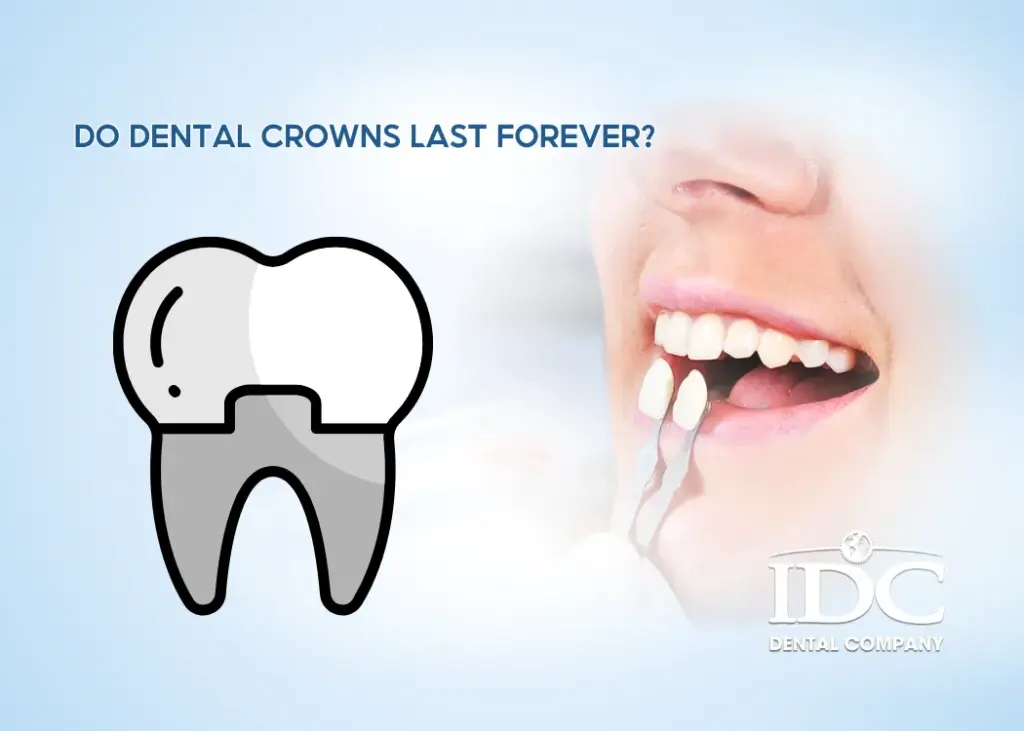
The actual lifespan of a dental crown depends on several factors, including the crown material, condition of the natural tooth underneath, oral hygiene, gum health, chewing forces, teeth grinding, and daily habits. Knowing these factors—and recognizing the early signs that a crown may need attention—can help you maintain your restoration and protect your natural tooth for as long as possible.
What Is a Dental Crown?
A dental crown is a custom-made restoration that covers the visible portion of a natural tooth. It is designed to restore the tooth’s shape, strength, appearance, and function while protecting the remaining tooth structure.
Dentists may recommend a crown for teeth that have:
- Large cavities or fillings
- Significant structural damage
- Cracks or fractures
- Severe wear
- Undergone root canal treatment
- Cosmetic concerns involving shape or appearance
Crowns are also used as part of dental implant treatment. In this situation, the crown is attached to an implant rather than covering a natural tooth.
Depending on the clinical situation and aesthetic requirements, dental crowns can be made from materials such as porcelain, zirconia, porcelain fused to metal (PFM), or metal alloys.
Are Dental Crowns Permanent?
Dental crowns are often described as permanent crowns, which can sometimes cause confusion.
In dentistry, a permanent crown generally means the final restoration that is cemented or bonded to the tooth. It is different from a temporary crown, which is typically worn for a short period while the final restoration is being fabricated.
A permanent crown is not intended to be removed by the patient. However, it can still wear, chip, loosen, fracture, or require replacement over time.
More importantly, the natural tooth underneath the crown remains biologically active and can still develop dental problems.
Therefore:
Permanent crown ≠ lifetime crown.
The term describes how the restoration is attached rather than guaranteeing that it will never need replacement.
How Long Do Dental Crowns Last?
A commonly cited range for the lifespan of a dental crown is approximately 10 to 15 years, although this should be viewed as a general estimate rather than an expiration date.
Some crowns need to be replaced earlier because of decay, fracture, gum problems, or excessive bite forces. Others remain comfortable and functional for significantly longer than 15 years.
A crown does not automatically become unusable once it reaches a particular age.
Instead, dentists evaluate factors such as:
- Structural condition of the crown
- Fit around the tooth
- Condition of the crown margins
- Health of the natural tooth underneath
- Gum and bone health
- Stability of the restoration
- Patient’s bite
- Presence of recurrent tooth decay
If an older crown remains healthy, stable, and functional, there may be no reason to replace it simply because it has been present for many years.
How Long Do Different Types of Dental Crowns Last?
The material used for a dental crown can influence its strength, appearance, wear characteristics, and resistance to fracture. However, material alone does not determine how long a crown will survive.
Porcelain Crowns
Porcelain crowns are popular because they can closely resemble natural teeth in color and translucency.
They are often selected when aesthetics are particularly important, especially in the visible areas of the smile.
Although modern dental ceramics can be strong, porcelain restorations may still chip or fracture when exposed to excessive forces, particularly in patients who grind their teeth or frequently bite hard objects.
Zirconia Crowns
Zirconia is widely used because of its high strength and favorable aesthetic properties.
Depending on the type of zirconia and restoration design, these crowns can be used for both front and back teeth.
Zirconia is highly resistant to fracture, but a strong material does not make a restoration indestructible. Crown design, tooth preparation, bonding or cementation, and bite forces remain important.
Porcelain-Fused-to-Metal Crowns
Porcelain-fused-to-metal, or PFM, crowns contain a metal substructure covered by tooth-colored porcelain.
They have been used successfully for many years and combine structural strength with acceptable aesthetics.
However, the porcelain layer can occasionally chip, and some patients may notice a darker margin near the gums as gum tissue changes over time.
Metal and Gold Crowns
Metal crowns are highly resistant to fracture and can withstand significant chewing forces.
Their primary disadvantage is appearance, which is why they are generally more acceptable for posterior teeth where they are less visible.
Regardless of material, proper diagnosis, crown design, fit, bite adjustment, and ongoing care are essential for long-term success.
What Determines How Long a Dental Crown Lasts?
Two people with the same type of crown may have very different outcomes. Several factors influence crown longevity.
1. Oral Hygiene
Good oral hygiene is one of the most important factors.
A common misconception is that a crowned tooth can no longer develop cavities. Although the crown itself cannot decay, the natural tooth underneath and around the crown margin can still develop tooth decay.
Plaque accumulation around the edge of a crown can increase the risk of cavities and gum inflammation.
Patients with crowns should continue to:
- Brush at least twice daily
- Clean between the teeth every day
- Pay particular attention to crown margins
- Attend regular dental examinations and professional cleanings
A crown protects a tooth, but it does not make the tooth immune to dental disease.
2. Condition of the Tooth Underneath the Crown
The amount and quality of natural tooth structure remaining beneath the crown can influence its long-term prognosis.
A tooth that has already suffered extensive decay, large fractures, multiple previous restorations, or other structural damage may have different long-term risks compared with a relatively intact tooth.
For this reason, dentists evaluate whether sufficient healthy tooth structure remains before placing a crown.
3. Crown Fit and Design
A well-designed crown should fit closely around the prepared tooth and work harmoniously with the surrounding teeth and bite.
Problems with crown margins or fit can make plaque control more difficult and may contribute to complications involving the tooth or gums.
The relationship between the crown and neighboring teeth is also important. Contacts that are inappropriate may cause food to become trapped between teeth.
4. Teeth Grinding and Clenching
Bruxism—the habit of grinding or clenching the teeth—can place considerable force on dental restorations.
Over time, excessive bite forces may contribute to:
- Crown wear
- Porcelain chipping
- Crown fracture
- Tooth fracture
- Jaw discomfort
For appropriate patients, a dentist may recommend a night guard to help manage the effects of grinding.
5. Eating and Daily Habits
Dental crowns are designed to tolerate normal chewing forces, but they should not be treated as tools.
Habits that may damage crowns include:
- Chewing ice
- Biting extremely hard candy
- Biting pens or pencils
- Using teeth to open packaging
- Cracking hard objects with the teeth
Avoiding these habits can help protect both crowns and natural teeth.
6. Gum Health
Healthy gums are important for the long-term stability of dental restorations.
Gum disease can lead to inflammation, recession, and loss of supporting bone. As gums recede, crown margins may become exposed, potentially affecting aesthetics and making certain areas more difficult to maintain.
Maintaining periodontal health is therefore an important part of crown care.
Can a Tooth Decay Under a Dental Crown?
Yes. A natural tooth can still develop decay underneath or around a dental crown.
The crown material itself cannot develop a cavity, but bacteria can affect the tooth structure around the crown margin.
Decay may occur when plaque repeatedly accumulates in this area, particularly when oral hygiene is inadequate or the crown margin has become compromised.
Possible warning signs include:
- New sensitivity
- Toothache
- Pain when biting
- Bad taste or odor
- Food trapping around the crown
- Changes around the crown margin
However, early decay does not always cause noticeable symptoms.
This is one reason regular dental examinations remain important even when a crowned tooth feels completely normal.
How Do You Know When a Dental Crown Needs to Be Replaced?
A crown should not necessarily be replaced simply because it is old. Dentists generally consider the clinical condition of both the restoration and the supporting tooth.
Signs that a crown may need professional evaluation include:
- Crown feels loose
- Crown repeatedly moves when chewing
- Crown has fallen off
- Porcelain is chipped or fractured
- Tooth hurts underneath the crown
- Persistent sensitivity develops
- Pain occurs when biting
- Gum around the crown remains inflamed
- Food frequently becomes trapped around the crown
- Crown margin becomes visibly exposed
- Decay develops underneath or around the crown
- Bite feels different
Some minor problems may be repairable, while others require crown replacement.
An examination is necessary to determine the appropriate treatment.
Does a Dental Crown Need to Be Replaced After 10 Years?
Not necessarily.
There is no universal rule stating that every dental crown must be replaced after 10 years.
If a 10-year-old crown is:
- Structurally intact
- Comfortable
- Stable
- Properly fitting
- Free from recurrent decay
- Surrounded by healthy gums
- Functioning correctly within the bite
there may be no clinical reason to replace it solely because of its age.
Likewise, a crown that is only a few years old may require treatment if it fractures, becomes loose, develops recurrent decay around the margin, or causes other complications.
In dentistry, the condition of the restoration is generally more important than its age alone.
Can Dental Crowns Last 20 Years or Longer?
Yes. Some dental crowns can remain functional for 20 years or even longer.
However, no dentist can guarantee that a specific crown will last for a particular number of years.
Long-term survival is more likely when several favorable factors occur together, including:
- Good oral hygiene
- Healthy gums
- Appropriate crown fit
- Adequate remaining tooth structure
- Balanced bite
- Controlled teeth grinding
- Regular dental examinations
- Avoidance of damaging habits
It is therefore better to think of a dental crown as a long-term restoration rather than a lifetime restoration.
What Happens If You Keep a Damaged Crown for Too Long?
A crown that is damaged, loose, or no longer fitting properly should be evaluated rather than ignored.
Depending on the problem, delaying treatment may allow additional complications to develop.
For example, decay around a compromised crown margin can progress deeper into the natural tooth. A cracked restoration may also expose or place additional stress on the underlying tooth.
Potential complications may include:
- Recurrent tooth decay
- Gum inflammation
- Tooth sensitivity
- Toothache
- Crown fracture
- Damage to the underlying tooth
- Pulp infection
- Need for root canal treatment
- Loss of restorable tooth structure
Early assessment may provide more treatment options than waiting until severe symptoms appear.
How Can You Make Dental Crowns Last Longer?
Although you cannot guarantee that a crown will last forever, good daily habits can help maximize its lifespan.
Brush Your Teeth Regularly
Brush twice daily using appropriate technique, paying particular attention to the area where the crown meets the natural tooth.
Plaque should not be allowed to accumulate along the gumline.
Clean Between Your Teeth
A toothbrush cannot effectively clean every surface between adjacent teeth.
Floss, interdental brushes, or other cleaning methods recommended by your dentist can help remove plaque around crowned teeth.
Avoid Using Your Teeth as Tools
Do not use crowns—or natural teeth—to open packages, cut materials, or crack hard objects.
These habits can cause fractures that might otherwise have been avoided.
Address Teeth Grinding
If you grind or clench your teeth, discuss it with your dentist.
Signs can include worn teeth, chipped restorations, morning jaw discomfort, headaches, or repeated dental fractures.
A custom night guard may be recommended in appropriate cases.
Maintain Healthy Gums
Daily plaque control and professional dental care help maintain healthy tissues around the crown.
This is particularly important because gum recession or periodontal disease can affect both the appearance and long-term health of crowned teeth.
Attend Regular Dental Checkups
A crown can look normal to the patient while early changes are developing underneath or around it.
During an examination, a dentist may evaluate:
- Crown stability
- Marginal fit
- Gum health
- Bite
- Signs of decay
- Cracks or fractures
- Supporting tooth structure
Dental X-rays may also be recommended when clinically appropriate.
What Happens When a Dental Crown Needs to Be Replaced?
If a dentist determines that an old crown needs replacement, treatment usually begins with an evaluation of the crown and underlying tooth.
The process may involve:
Dental examination → X-ray when needed → removal of the old crown → evaluation of the underlying tooth → necessary treatment → preparation or refinement of the tooth → digital scan or impression → fabrication of a new crown → final placement.
What happens next depends largely on the condition of the tooth underneath.
If the tooth remains healthy
The tooth may be prepared as needed and restored with a new crown.
If decay is present
The decayed tooth structure must be removed before the tooth can be restored.
If the dental pulp is affected
Root canal treatment may be necessary when clinically indicated.
If the tooth cannot be restored
If there is insufficient healthy tooth structure or the tooth has suffered severe damage, extraction and tooth-replacement options may need to be discussed.
This is another reason not to ignore symptoms developing around an existing crown.
Can an Old Dental Crown Be Replaced?
Yes. Dental crowns can usually be replaced when necessary, provided the underlying tooth can still be restored.
Replacing a crown does not automatically mean losing the natural tooth.
The dentist first removes or accesses the existing restoration and evaluates what is underneath. If the remaining tooth is healthy enough to support another restoration, a new crown can often be fabricated.
If decay or another dental problem is discovered, it should be treated before the new crown is placed.
Dental Crown vs. Dental Implant: Are They the Same?
A dental crown and dental implant are not the same thing.
A traditional dental crown covers an existing natural tooth.
A dental implant replaces the root portion of a missing tooth and is placed into the jawbone. A separate implant crown is then attached to the implant.
This distinction is important when discussing longevity.
A dental implant may remain stable while the crown attached to it eventually becomes worn, chipped, or requires replacement. Therefore, the lifespan of an implant crown and the lifespan of the dental implant itself should be considered separately.
When Should You See a Dentist About an Existing Crown?
You do not need to wait until a crown falls off or causes severe pain before having it checked.
Schedule a dental evaluation if you notice:
- Persistent toothache
- New or increasing sensitivity
- Pain when chewing
- Loose crown
- Broken or chipped crown
- Swelling around the tooth
- Persistent bleeding around the crown
- Bad taste or odor
- Food repeatedly becoming trapped
- Changes in your bite
If you have no symptoms, routine dental examinations still allow your dentist to monitor existing restorations and the teeth supporting them.
Frequently Asked Questions About Dental Crown Lifespan
How long do dental crowns usually last?
Many dental crowns can last approximately 10 to 15 years or longer, but their actual lifespan varies considerably. Oral hygiene, crown material, bite forces, gum health, tooth condition, and daily habits all influence longevity.
Do dental crowns last forever?
No. Dental crowns are long-term fixed restorations, but they are not guaranteed to last a lifetime. They may eventually require repair or replacement.
Can a dental crown last 20 years?
Yes. Some crowns remain functional for 20 years or longer, especially when the supporting tooth and gums remain healthy and the crown is properly maintained. However, this cannot be guaranteed for every patient.
Do crowns need to be replaced every 10 years?
No. A crown does not automatically need replacement when it reaches 10 years. If it remains healthy, stable, comfortable, and functional, a dentist may recommend continuing to monitor it.
Can teeth decay underneath crowns?
Yes. The crown itself cannot develop tooth decay, but the natural tooth underneath and around the crown margin can still develop cavities.
How do I know if my crown needs replacing?
Possible signs include pain, persistent sensitivity, looseness, fracture, recurrent decay, gum inflammation, food trapping, or changes in the bite. Some problems have no obvious symptoms, which is why routine dental examinations are important.
Can an old dental crown be replaced?
Yes. If the underlying tooth remains restorable, an old or damaged crown can generally be removed and replaced with a new restoration.
What type of dental crown lasts the longest?
There is no single crown material that is best or longest-lasting for every patient. Zirconia and metal restorations can offer high strength, while other materials may provide different aesthetic or functional advantages. The best option depends on the tooth location, bite, appearance requirements, remaining tooth structure, and other clinical factors.


 WhatsApp