
Braces after 30 can still be an effective option for adults who want to straighten crowded or crooked teeth, close gaps, improve protruding teeth, or correct certain bite problems. Although orthodontic treatment is often associated with children and teenagers, there is no universal age limit for getting braces. Healthy teeth can be moved at virtually any age.
The main difference is that adult orthodontic treatment may require more careful planning. By your 30s, jaw growth is generally complete, and you may already have dental work or oral health concerns such as crowns, missing teeth, implants, gum recession, or periodontal disease.
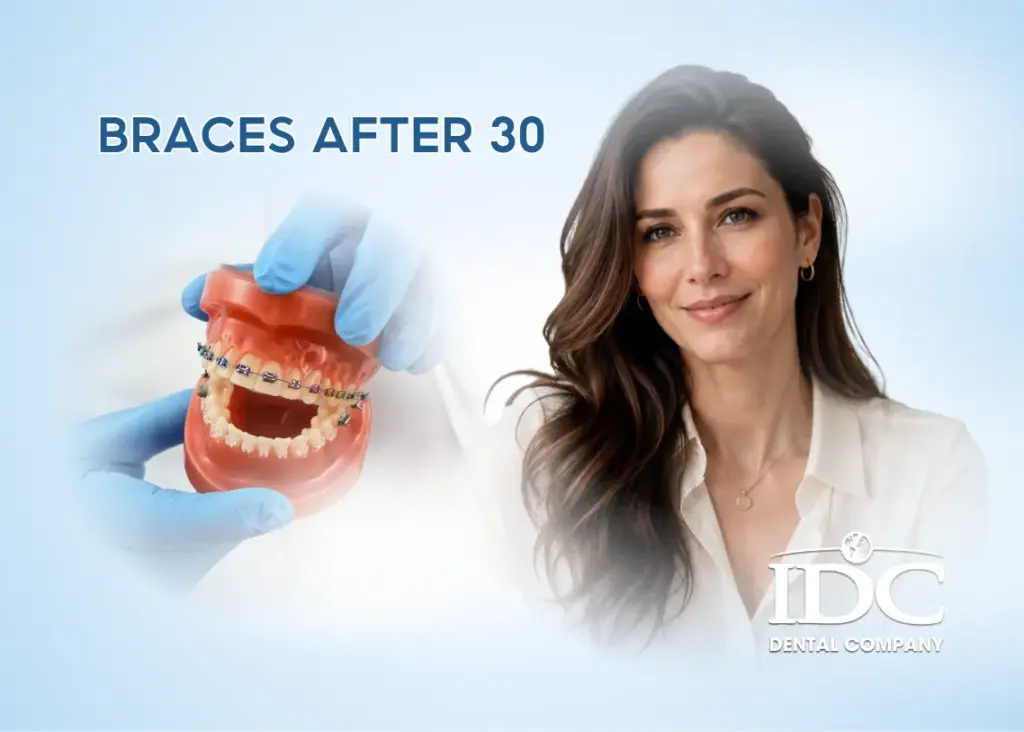
The good news is that modern orthodontics offers several treatment options for adults, including traditional braces, ceramic braces, and clear aligners. According to the American Association of Orthodontists (AAO), adults now represent a substantial proportion of orthodontic patients.
So, is 30 too old for braces? In most cases, age itself is not the deciding factor. Your gum health, bone support, tooth condition, bite, and overall treatment needs are much more important.
Are Braces After 30 Still Effective?
Yes. Braces can still be effective after age 30.
Orthodontic treatment works by applying controlled forces to the teeth. Over time, the tissues and bone surrounding the tooth roots remodel, allowing the teeth to gradually move toward their planned positions.
This biological process does not suddenly stop when you reach adulthood. The AAO notes that teeth continue to respond to orthodontic forces regardless of age, although adult treatment can differ because the jaws have finished growing and adult bone is more mature.
Therefore, people in their 30s, 40s, 50s, and beyond may still be candidates for orthodontic treatment.
However, successful treatment depends on having adequate periodontal support and a treatment plan appropriate for your individual dental condition.
Is 30 Too Old for Braces?
No. Turning 30 does not automatically make you too old for braces.
One of the most important factors is the health of your teeth and gums rather than your chronological age. The AAO specifically identifies dental disease, periodontal disease, missing teeth, existing restorations, certain habits, and other oral health factors as considerations when planning orthodontic treatment for adults.
For example, a 38-year-old with healthy gums and good bone support may be an excellent orthodontic candidate, while a younger person with uncontrolled periodontal disease may need treatment for their gum condition before braces can safely begin.
That is why an orthodontic examination is important before deciding whether braces or clear aligners are appropriate.
How Do Braces Move Adult Teeth?
Traditional braces use brackets attached to the teeth and an archwire that applies controlled pressure. Additional components, such as elastics, may sometimes be used to help move particular teeth or improve the bite.
The pressure produced by orthodontic appliances initiates changes in the tissues surrounding the roots. Bone is gradually remodeled as the teeth move.
The same fundamental process occurs in adults and teenagers.
However, orthodontic tooth movement must be carefully controlled. Applying excessive force does not simply make treatment faster and can increase the risk of unwanted effects.
This is particularly important for adults who already have reduced bone support or a history of periodontal disease.
How Are Braces After 30 Different From Braces for Teenagers?
While the basic principles of orthodontics remain the same, adult treatment can present different challenges.
Jaw Growth Is Already Complete
Children and teenagers may still have developing jaws. In selected cases, orthodontists can use growth to help manage certain jaw relationships.
Adults no longer have this growth potential.
For relatively straightforward dental problems, this may not be a significant limitation. However, severe skeletal problems involving the position or size of the jaws may require a different treatment approach.
For example, a severe skeletal underbite or significant jaw discrepancy may sometimes require orthodontics combined with orthognathic surgery rather than braces alone.
Tooth Movement May Take More Time
Adult bone is mature and generally denser than developing bone. As a result, some adults may experience slower orthodontic tooth movement compared with younger patients with similar conditions.
However, treatment duration depends on much more than age.
The complexity of the bite, amount of crowding, number of teeth that need to move, periodontal condition, treatment method, and patient cooperation can all influence how long braces take.
Adults Often Have More Complex Dental Histories
By age 30 or older, you may already have:
- Dental fillings
- Root canal-treated teeth
- Dental crowns
- Bridges
- Missing teeth
- Dental implants
- Gum recession
- Periodontal disease
- Bone loss
- Worn or damaged teeth
These conditions do not necessarily prevent orthodontic treatment. However, they may require additional planning or coordination between an orthodontist, general dentist, periodontist, prosthodontist, or oral surgeon.
What Problems Can Braces Correct After 30?
Adult orthodontics can address many of the same tooth alignment and bite problems treated in younger patients.
Crowded or Crooked Teeth
Crowding occurs when there is not enough space within the dental arch for the teeth to align normally. Teeth may overlap, rotate, or erupt in unfavorable positions.
In addition to affecting appearance, severe crowding can create areas that are more difficult to brush and floss.
Braces or clear aligners may be used to gradually reposition the teeth and improve alignment.
Protruding Teeth
Front teeth that project too far forward may affect the appearance of the smile and facial profile.
If protrusion is primarily related to tooth position, orthodontic treatment may help move the teeth into better alignment.
However, significant protrusion involving the underlying jaw structure requires a more comprehensive evaluation.
Gaps Between Teeth
Spaces can develop because of differences between tooth and jaw size, missing teeth, tooth position, or other factors.
Orthodontics can sometimes close these spaces completely. In other cases, the orthodontist may redistribute the spaces so that veneers, bonding, implants, or other restorative treatments can later create a more balanced result.
Overbite
An excessive overbite occurs when the upper front teeth overlap the lower front teeth too much vertically.
Depending on the cause and severity, adult braces or clear aligners may help improve the relationship between the upper and lower teeth.
Underbite
An underbite occurs when the lower front teeth sit in front of the upper front teeth.
Mild or primarily dental underbites may sometimes be treated orthodontically. Severe skeletal underbites may require additional treatment.
Crossbite and Open Bite
Adult orthodontics may also be used to treat certain crossbites and open bites.
Because these conditions can have dental, skeletal, or functional causes, accurate diagnosis is important before treatment begins.
Who Needs Special Evaluation Before Getting Braces After 30?
Some adults require additional dental treatment before orthodontics can begin.
Adults With Gum Disease
Periodontal health is particularly important in adult orthodontics.
Moving teeth when periodontal disease is active or poorly controlled can increase the risk of problems involving the gums, roots, and supporting tissues. The AAO emphasizes that an in-person examination is important for evaluating periodontal health before and during treatment.
If you have periodontitis, treatment may first focus on controlling inflammation and stabilizing your periodontal condition.
Once the disease is stable, orthodontic treatment may be possible in selected cases with careful monitoring.
Adults With Bone Loss
Teeth depend on the surrounding alveolar bone for support.
When significant bone loss is present, orthodontic treatment must be planned carefully. The amount and direction of tooth movement, as well as the forces used, may need to be modified.
Adults With Missing Teeth
Having missing teeth does not automatically prevent you from getting braces.
In fact, orthodontics can sometimes be an important part of treating missing teeth.
For example, braces may be used to:
- Close an unwanted space
- Upright teeth that have tilted into an empty space
- Redistribute space
- Create an appropriate site for a future dental implant
This requires coordination between orthodontic and restorative treatment.
Adults With Dental Crowns
Many people wonder whether crowns prevent teeth from moving.
They generally do not. The AAO states that teeth with crowns can be orthodontically moved.
However, the condition of the underlying tooth, root, crown, and surrounding tissues should be assessed before treatment.
Adults With Dental Implants
Dental implants require special consideration.
Unlike natural teeth, implants are integrated into the jawbone and do not move through bone in the same way natural teeth do.
Therefore, an existing implant often needs to be treated as a fixed position when the orthodontic plan is designed.
If both orthodontic treatment and an implant are needed, orthodontics is often planned first so the appropriate space and tooth positions can be established before implant placement.
What Types of Braces Are Available After 30?
Adults today have several orthodontic options.
Traditional Metal Braces
Metal braces remain a reliable choice for treating a wide range of orthodontic problems.
They provide good control over tooth movement and may be particularly useful for complex cases.
The main consideration for some adults is their visibility.
Ceramic Braces
Ceramic braces work similarly to conventional braces but use brackets designed to blend more closely with the natural color of the teeth.
They can provide a less noticeable appearance while still using a fixed orthodontic system.
Clear Aligners
Clear aligners are removable trays designed to gradually reposition the teeth.
They are popular among adults because they are discreet and can be removed while eating, brushing, and flossing.
However, clear aligners require good compliance. Patients must wear them for the recommended amount of time each day.
They are also not automatically the best option for every orthodontic problem. Appliance selection should follow diagnosis rather than being based only on appearance or convenience.
Braces vs. Clear Aligners After 30: Which Is Better?
Neither option is universally better.
Traditional braces are fixed to the teeth, which means treatment does not depend on remembering to put the appliance back in after meals. They can also provide excellent control for many complex tooth movements.
Clear aligners offer greater discretion and can make eating and oral hygiene more convenient because the trays are removable.
However, aligners require consistent wear and may not be ideal for every type of tooth or bite movement.
The best choice depends on your orthodontic problem, lifestyle, treatment goals, oral health, and ability to follow treatment instructions.
How Long Do Braces Take After 30?
There is no standard treatment duration for everyone over 30.
The American Dental Association notes that orthodontic treatment commonly lasts approximately one to three years, although individual treatment times vary considerably.
Factors that can affect treatment time include:
- Severity of crowding
- Complexity of the bite
- Amount of tooth movement required
- Need for tooth extraction
- Missing teeth
- Periodontal condition
- Type of orthodontic appliance
- Biological response to treatment
- Patient compliance
- Attendance at follow-up appointments
Therefore, two people who both start braces at age 35 may have very different treatment timelines.
A personalized estimate can usually be provided only after examination, imaging, and orthodontic analysis.
Do You Need Teeth Extracted for Braces After 30?
Not necessarily.
Many adults complete orthodontic treatment without having permanent teeth removed.
However, extraction may be considered when there is severe crowding, significant protrusion, insufficient space within the dental arch, or a tooth with a poor long-term prognosis.
Depending on the individual case, alternative strategies may include interproximal reduction, controlled arch development, distal movement of teeth, or using existing spaces from previously missing teeth.
The decision should be based on the overall facial profile, bite, periodontal condition, dental arch, and treatment goals—not simply on age.
Do Braces Hurt More After 30?
Getting braces after 30 does not necessarily mean treatment will be significantly more painful.
It is common to experience temporary pressure or tenderness after braces are placed, wires are adjusted, or a new set of aligners is started.
This discomfort generally decreases as the mouth adapts.
However, persistent severe pain, significant tooth mobility, gum swelling, bleeding, or other unusual symptoms should be evaluated by your dental professional.
What Are the Benefits of Getting Braces After 30?
One of the most obvious benefits is improved tooth alignment.
But adult orthodontic treatment can offer more than cosmetic improvement.
Properly aligned teeth may be easier to brush and floss. Correcting certain bite problems can also improve how the upper and lower teeth contact each other and may reduce abnormal tooth wear in suitable cases. The AAO identifies oral hygiene, bite function, chewing, and confidence among potential benefits of adult orthodontic treatment.
Orthodontics can also support restorative dentistry.
If you are missing a tooth, for example, braces may reposition neighboring teeth to create the correct amount of space before implant treatment.
For many adults, the final result is therefore not simply “straighter teeth” but a more coordinated treatment plan for long-term dental health.
What Happens Before Getting Braces After 30?
Adult orthodontic treatment should begin with a comprehensive evaluation.
Your dentist or orthodontist will examine your teeth, bite, gums, existing restorations, and periodontal health.
Orthodontic records may include photographs, digital scans or impressions, and dental X-rays. X-rays are particularly important because they provide information about tooth roots, bone, impacted teeth, and other structures that cannot be fully assessed from photographs or scans alone.
If problems such as cavities, active periodontal disease, or dental infections are identified, these may need to be treated before orthodontic tooth movement begins.
A personalized treatment plan can then determine:
- Which teeth need to move
- Whether extraction is necessary
- Whether braces or aligners are more appropriate
- Whether other dental specialists should be involved
- Approximate treatment duration
- Long-term retention strategy
How to Get the Best Results From Braces After 30
Your participation plays an important role in successful orthodontic treatment.
Maintain excellent oral hygiene throughout treatment, particularly around brackets and wires where plaque can accumulate more easily.
The AAO emphasizes the importance of additional attention to cleaning during orthodontic treatment because appliances create more areas where plaque can collect.
You should also attend scheduled appointments, wear elastics or clear aligners as instructed, avoid foods that may damage fixed braces, and continue routine dental examinations and professional cleanings.
For adults with a history of periodontal disease, ongoing periodontal monitoring may also be recommended.
Finally, do not underestimate the importance of retainers.
Teeth naturally have a tendency to shift after orthodontic treatment. Wearing your retainer according to professional instructions helps maintain the new tooth positions.
Frequently Asked Questions About Braces After 30
Can you get braces at 30?
Yes. Healthy teeth can generally be moved orthodontically at any age. Your oral and periodontal health matter more than simply being over 30.
Is 35 too old for braces?
No. Being 35 does not automatically prevent you from receiving orthodontic treatment. Your dentist or orthodontist will evaluate your teeth, gums, bone support, bite, and dental history.
Can you get braces at 40?
Yes. Many people receive orthodontic treatment in their 40s and beyond. Treatment needs and complexity vary between individuals.
Do braces take longer after 30?
They can, but not always. Adult bone is mature, and some tooth movements may take longer, but treatment duration depends heavily on the complexity of the individual case.
Can you get braces if you have crowns?
Yes, teeth with crowns can often be moved orthodontically. The crown and underlying tooth should first be evaluated.
Can you get braces with missing teeth?
Yes. Orthodontics can sometimes close missing-tooth spaces or create and maintain appropriate spaces for future restorations or implants.
Can you get braces if you have gum disease?
Possibly, but active periodontal disease generally needs to be treated and stabilized before orthodontic tooth movement. Gum and bone health should be carefully evaluated and monitored.
Are clear aligners effective after 30?
Yes, clear aligners can be effective for many adults. However, their suitability depends on the type and complexity of tooth movement required.

 WhatsApp