
Unattractive front teeth can affect your smile due to concerns such as discoloration, gaps, chips, uneven shapes, or misalignment. Fortunately, treatments such as teeth whitening, composite bonding, veneers, dental crowns, and orthodontics can help improve their appearance.
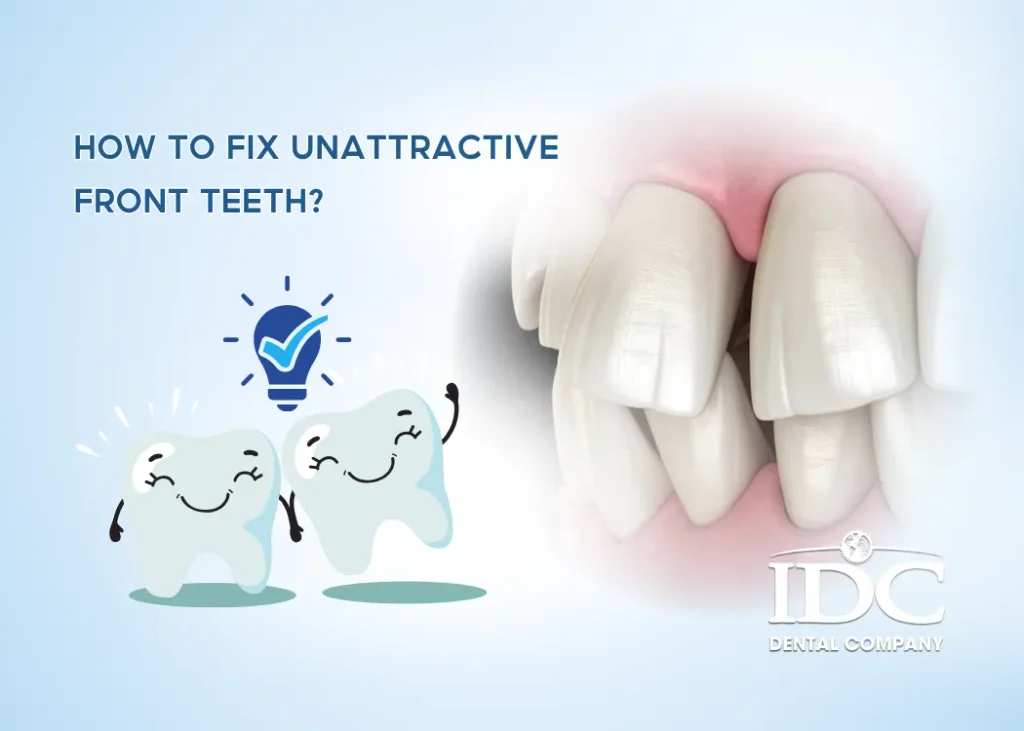
The right solution depends on the condition of your teeth, gums, bite, and the cause of the cosmetic concern. This guide explores seven effective ways to improve your front teeth and create a more natural, balanced smile.
What are considered unattractive front teeth?
There is no universal definition of a perfect smile. Tooth shape, size, color, and even small variations between teeth are natural, and what one person considers unattractive may not bother someone else.
From a cosmetic dentistry perspective, common concerns involving the front teeth include:
- Yellow or discolored teeth
- Gaps between front teeth
- Crooked or rotated teeth
- Protruding front teeth
- Chipped or cracked teeth
- Uneven tooth lengths
- Teeth that appear too large or too small
- Short or worn front teeth
- Misshapen teeth
- Old or discolored fillings
- Uneven gum lines
Sometimes only one front tooth is affected. In other cases, several teeth may contribute to an uneven-looking smile.
Why are front teeth so important to your smile?
The front teeth, particularly the upper incisors, play a major role in smile aesthetics. Their width, length, position, color, and relationship with the lips and gums can influence the overall appearance of the face.
Front teeth are also important for biting food, supporting the lips, and helping with speech. Therefore, cosmetic treatment should consider function as well as appearance.
What causes front teeth to look unattractive?
Understanding the cause is important because different problems require different solutions.
Genetics and natural tooth shape
Some people naturally have larger, smaller, shorter, or differently shaped teeth. The relationship between tooth size and jaw size can also affect spacing and alignment.
For example, relatively small teeth in a larger dental arch may result in gaps, while larger teeth in a smaller arch can contribute to crowding.
Crooked or misaligned teeth
Front teeth may overlap, rotate, or erupt in an uneven position. Crowding can occur when there is insufficient space in the dental arch.
Minor irregularities may primarily affect appearance, while more significant misalignment can also influence the bite and make cleaning more difficult.
Gaps between front teeth
A gap between the two upper front teeth is sometimes referred to as a diastema.
Spacing can be associated with several factors, including:
- Small teeth relative to the jaw
- Missing teeth
- Differences in tooth size
- An abnormal labial frenum
- Tongue-thrusting habits
- Tooth movement associated with periodontal disease
The cause and width of the gap help determine whether bonding, veneers, orthodontics, or another treatment may be appropriate.
Protruding front teeth
Front teeth may appear to stick out because of their position, the underlying jaw structure, or a combination of both.
This distinction is important. Cosmetic restorations can alter the visible shape of a tooth, but they cannot move the tooth root or reposition the jaw.
Tooth discoloration
Front teeth can become darker or more yellow because of:
- Coffee and tea
- Tobacco
- Certain foods and beverages
- Aging
- Dental trauma
- Certain medications
- Previous root canal treatment
The type and severity of discoloration influence which cosmetic treatment is appropriate.
Chipped or broken teeth
Because of their position, front teeth are particularly vulnerable to trauma.
A tooth may become chipped or fractured after a fall, sports injury, accident, biting a hard object, or teeth grinding. Tooth decay and large existing fillings can also weaken the remaining tooth structure.
Tooth wear
Grinding, clenching, acid erosion, and certain bite problems can gradually wear down the edges of the front teeth. The teeth may begin to look shorter, uneven, flattened, or chipped.
Do unattractive front teeth always need treatment?
No. Aesthetic differences do not automatically mean that something is medically wrong with your teeth.
If your teeth and gums are healthy and the concern is purely cosmetic, treatment is generally a personal choice.
However, dental treatment may be more important when the appearance of a tooth is related to:
- Tooth decay
- A significant fracture
- Dental infection
- Gum or periodontal disease
- Severe tooth wear
- Bite problems
- Functional difficulties
Before cosmetic treatment, a dentist should identify whether the issue is purely aesthetic or whether there is an underlying oral health problem that needs to be addressed.
How does a dentist evaluate front teeth before cosmetic treatment?
Improving front teeth involves more than simply choosing a whiter shade or making every tooth the same shape.
A dentist may evaluate:
- Tooth position and alignment
- Tooth length and width
- Tooth proportions
- Enamel condition
- Tooth color
- Existing fillings, veneers, or crowns
- Gum health
- Gum line
- Bite and occlusion
- Tooth wear
- Smile line
- Lip position
- Facial proportions
Depending on the situation, dental X-rays, photographs, digital scans, or other diagnostic tools may also be used.
The goal is to identify the cause of the concern and choose a treatment that improves appearance without unnecessarily compromising healthy tooth structure.
7 Ways to improve unattractive front teeth
The best way to improve your front teeth depends on what you would like to change. Here are seven commonly considered options.
1. Professional teeth whitening
If your front teeth are healthy and well aligned but appear yellow or stained, professional teeth whitening may be one of the simplest cosmetic options.
Whitening can help improve discoloration caused by aging and certain foods, beverages, or lifestyle factors.
However, whitening primarily changes tooth color. It does not change the position, size, or shape of your teeth.
For example, whitening will not correct:
- Crooked teeth
- Gaps
- Chipped teeth
- Protruding teeth
- Uneven tooth lengths
Whitening may also be less effective for certain types of internal discoloration.
Another consideration is that existing dental restorations such as crowns, veneers, and composite fillings generally do not whiten in the same way as natural tooth enamel. This needs to be considered when planning treatment for visible front teeth.
2. Composite bonding
Composite bonding is a conservative cosmetic procedure that uses tooth-colored resin to modify the shape or appearance of a tooth.
The material is applied to the tooth, carefully shaped, and polished to blend with the surrounding teeth.
Composite bonding may be used for:
- Small chips
- Minor gaps
- Small front teeth
- Slightly uneven tooth edges
- Minor shape irregularities
- Selected areas of discoloration
One of the main advantages of bonding is that it can often improve a tooth with minimal alteration of healthy tooth structure.
It can also be repaired or modified if necessary.
However, composite resin is not as resistant to staining and wear as some ceramic materials. Over time, bonding may become discolored, worn, or chipped and may require polishing, repair, or replacement.
Bonding is also not appropriate for every case. A large gap, significant tooth damage, or certain bite problems may require another approach.
3. Porcelain veneers
Porcelain veneers are thin restorations that are bonded primarily to the visible front surface of the teeth.
They can be used to modify several cosmetic characteristics simultaneously, including:
- Tooth color
- Shape
- Size
- Minor spacing
- Small chips
- Mild aesthetic irregularities
Veneers may be particularly useful when a patient wants to improve both the color and shape of the front teeth.
For example, someone with small front teeth, minor gaps, and discoloration may be able to address several concerns with a carefully planned veneer treatment.
Do veneers require shaving the teeth?
The amount of tooth preparation varies.
Some cases require only minimal preparation, while others require more space to be created for the ceramic restoration. “No-prep veneers” may be possible in selected cases, but they are not appropriate for everyone.
Factors such as tooth position, enamel thickness, existing color, desired changes, and bite all influence how the teeth need to be prepared.
Veneers may not be appropriate for significant misalignment, certain bite problems, active gum disease, or teeth with extensive structural damage.
4. Dental crowns
Dental crowns can improve both the function and appearance of damaged front teeth.
Unlike a veneer, which primarily covers the visible facial surface, a crown generally covers most or all of the clinical crown of the natural tooth.
A front tooth may need a crown when it has:
- A significant fracture
- Extensive decay
- A large existing filling
- Substantial loss of tooth structure
- Certain conditions following root canal treatment
- Structural problems that cannot be adequately managed with a more conservative restoration
A crown can also change the visible color, shape, size, and proportions of a tooth.
Should healthy front teeth be crowned just to make them look better?
This requires careful consideration.
Because preparing a tooth for a crown generally involves removing more tooth structure than bonding or a veneer, conservative alternatives should be evaluated when the natural tooth is healthy.
For example, a small gap may be treated with bonding, while crooked healthy teeth may be better addressed with orthodontics.
A crown can be an excellent restoration when there is an appropriate structural indication, but it should not automatically be the first choice for every cosmetic concern.
5. Orthodontic treatment
If your main concern is that your front teeth are crooked, crowded, widely spaced, or protruding, orthodontic treatment may be more appropriate than trying to mask their position with restorations.
Options may include:
- Traditional braces
- Clear aligners
Orthodontics works differently from veneers and crowns.
Rather than changing the visible shape of the tooth, orthodontic treatment gradually moves the natural tooth into a different position.
This distinction is particularly important for healthy teeth.
For example, if a healthy front tooth is significantly rotated, placing a crown over it may require considerable tooth preparation. Orthodontic treatment may be able to reposition the natural tooth while preserving its structure.
Can Crowns Fix Protruding Front Teeth?
Crowns may alter the visible shape of mildly protruding teeth in carefully selected situations, but they do not move the roots of the teeth or change the underlying jaw position.
If protrusion is moderate or significant, an orthodontic evaluation is usually important before considering cosmetic restorations.
6. Repairing chipped, Broken, or Missing front teeth
The right treatment for a damaged front tooth depends on how much tooth structure has been lost.
Minor chipped front tooth
A very small chip may sometimes require only minor contouring or polishing. Other cases can be restored with composite bonding.
Veneers may also be considered when there are additional cosmetic concerns involving the tooth.
Larger broken front tooth
A larger fracture requires a more detailed evaluation.
The dentist may need to determine:
- How much healthy tooth structure remains
- Whether the pulp is affected
- Whether the root is intact
- Whether there is an existing restoration
- How the tooth contacts the opposing teeth
Depending on these factors, treatment may involve bonding, a crown, root canal treatment when clinically indicated, or another restorative approach.
Missing front tooth
If a front tooth cannot be saved or is already missing, replacement options may include:
- A dental implant
- A dental bridge
- Other prosthetic solutions
The appropriate option depends on the condition of the bone, gums, adjacent teeth, bite, and overall oral health.
7. A Personalized smile makeover
Some people are concerned about more than one aspect of their front teeth.
For example, a patient may have:
- Several uneven teeth
- A small gap
- Discoloration
- Worn tooth edges
- Different tooth sizes
- An uneven gum line
In these situations, a smile makeover may involve combining several treatments rather than using the same procedure on every tooth.
Depending on the individual, a treatment plan might include:
- Teeth whitening
- Composite bonding
- Porcelain veneers
- Dental crowns
- Orthodontics
- Gum contouring when appropriate
- Dental implants for missing teeth
A smile makeover should be personalized. It does not necessarily mean placing veneers or crowns on every visible tooth.
How can you fix a gap between front teeth?
The right treatment for a gap between front teeth depends on its size and cause.
A small gap between proportionally small teeth may respond well to composite bonding or veneers.
If there are multiple spaces or the teeth are positioned too far apart, orthodontic treatment may be more appropriate.
If the spacing has developed because of periodontal disease, the gum and supporting tissues need to be treated before cosmetic closure of the gap is considered.
It is also important to evaluate tooth proportions.
Closing a large gap by simply making the two central incisors much wider can result in teeth that look disproportionately large. In some cases, the space needs to be redistributed among several teeth or reduced orthodontically before cosmetic treatment.
How can protruding front teeth be improved?
Protruding front teeth may be caused by the position of the teeth, jaw structure, or both.
When the main problem is tooth position, braces or clear aligners may be used to move the teeth.
In selected mild cases, veneers or crowns may modify the visible shape of the teeth, but these restorations do not move the roots.
If the protrusion is related primarily to the jaw, restorative dentistry cannot correct the skeletal cause.
For this reason, identifying why the teeth protrude is essential before deciding between orthodontic and cosmetic treatment.
How can crooked or uneven front teeth be fixed?
“Uneven front teeth” can describe several different problems.
One tooth may be longer than another, the edges may be worn, a tooth may be rotated, or the gum line may be uneven.
Treatment depends on the cause.
Minor differences in tooth length may sometimes be improved with bonding or conservative reshaping. Veneers may help selected shape and proportion concerns.
If the teeth are actually positioned incorrectly, orthodontics may provide a more appropriate solution.
When the visible difference comes from the gum line rather than the teeth themselves, periodontal or gum treatment may be considered in selected cases.
What if your front teeth look too big?
Before reducing the size of a tooth, it is important to determine whether the tooth is actually oversized.
Front teeth can sometimes appear too large because:
- The neighboring teeth are unusually small
- The teeth protrude
- The visible tooth length is affected by the gum line
- The natural tooth shape is relatively wide
Simply grinding down healthy front teeth is not always the appropriate solution.
The entire smile and tooth proportions should be evaluated before deciding whether reshaping, orthodontics, bonding, veneers, or another approach would provide a more balanced result.
What If Your Front Teeth Are Small or Short?
Small or short-looking front teeth may be related to natural tooth size, wear, tooth shape, or the amount of tooth covered by the gums.
Composite bonding can sometimes add length or width to small teeth.
Veneers can also modify tooth proportions when the teeth and bite are suitable.
Crowns may be appropriate when there is significant structural damage, while gum treatment may be considered if excessive gum coverage is contributing to the appearance.
Again, treatment should address the actual cause rather than simply making the teeth larger.
Bonding vs Veneers vs Crowns for Front Teeth
These three treatments are often confused because all can change the appearance of front teeth, but they serve different purposes.
Composite bonding is generally the most conservative option for small cosmetic changes such as minor chips, gaps, or shape irregularities.
Porcelain veneers primarily cover the visible surface and can provide more extensive changes to tooth shape and color.
Dental crowns cover more of the tooth and are often more appropriate when substantial structural restoration is required.
If the natural tooth is healthy, it is important to consider whether a conservative option can achieve the desired result before choosing full crown coverage.
Veneers or Crowns: Which Is Better for Front Teeth?
Neither option is universally better.
Veneers may be considered when:
- The teeth are relatively healthy
- The main concerns involve shape or color
- There is adequate enamel
- The bite is appropriate
Crowns may be considered when:
- A significant amount of tooth structure is missing
- The tooth contains a large restoration
- The tooth requires full coverage
- Structural protection is needed
And sometimes neither is necessary.
Whitening, bonding, or orthodontics may provide a more conservative solution.
Can You Improve Front Teeth Without Shaving Them?
In some cases, yes.
Professional whitening does not require tooth reduction. Composite bonding can often be performed with minimal or no removal of healthy tooth structure, depending on the situation.
Orthodontic treatment moves the teeth rather than covering them with restorations.
Some veneer cases may require very little preparation, but completely no-prep treatment is not appropriate for everyone.
If preserving natural enamel is a priority, discuss all conservative options before deciding on irreversible restorative treatment.
What Makes Cosmetic Front Teeth Look Natural?
Natural-looking cosmetic dentistry is about much more than choosing a white shade.
Several factors need to work together.
Tooth Proportions
The width and length of the front teeth should be balanced with each other and the surrounding teeth.
Tooth Shape
Rounded, square, or more tapered shapes can create different appearances and should complement the face and smile.
Color and Translucency
Natural teeth are not completely opaque or uniformly white. Subtle variations in color and translucency contribute to a realistic appearance.
Surface Texture
Small surface characteristics can affect how light reflects from the teeth.
Gum Line
The shape and position of the gums influence the visible length and symmetry of the teeth.
Smile Line and Facial Proportions
Teeth should be evaluated in relation to the lips, face, and overall smile rather than in isolation.
Bite
A beautiful restoration also needs to function properly during biting and chewing.
Teeth that are extremely white, overly large, or completely identical may not necessarily produce the most natural-looking smile.
How Long Does It Take to Improve Front Teeth?
Treatment time varies considerably.
Professional whitening and composite bonding are generally among the quicker cosmetic options.
Veneers and crowns require additional steps such as consultation, treatment planning, preparation when necessary, impressions or digital scans, fabrication, and final placement.
Orthodontic treatment generally takes longer because teeth need to move gradually.
Dental implant treatment may require additional healing time depending on bone and gum conditions.
For this reason, patients should avoid selecting treatment solely because it appears to provide the fastest cosmetic change.
How Much Does It Cost to Fix Unattractive Front Teeth?
There is no single price for improving front teeth because the treatment can range from whitening one smile to restoring several damaged teeth.
Cost depends on factors such as:
- Type of treatment
- Number of teeth involved
- Complexity
- Materials
- Condition of the natural teeth
- Gum health
- Need for orthodontics
- Need for additional restorative treatment
A small chip repaired with composite bonding will have a very different treatment plan from multiple veneers, crowns, orthodontics, or a complete smile makeover.
A dental examination is therefore necessary to determine the appropriate treatment and provide an accurate estimate.
What Should Be Treated Before Cosmetic Dentistry?
Cosmetic treatment should ideally be performed on a healthy oral foundation.
Before veneers, crowns, bonding, or other aesthetic procedures, active problems may need to be addressed, including:
- Tooth decay
- Gum inflammation
- Periodontal disease
- Dental infection
- Untreated fractures
- Unstable bite problems
Covering an unhealthy tooth with a cosmetic restoration does not eliminate the underlying disease.
Common Mistakes to Avoid When Improving Front Teeth
When considering cosmetic treatment, avoid focusing only on speed or dramatic visual changes.
Common mistakes include:
- Making teeth excessively white
- Making the front teeth too large
- Crowning healthy teeth without considering conservative alternatives
- Ignoring bite problems
- Ignoring gum health
- Using veneers to mask significant tooth misalignment
- Closing a large gap by making only two teeth excessively wide
- Focusing on individual teeth instead of the overall smile
- Choosing treatment based only on price
- Assuming the same treatment is appropriate for everyone
Good cosmetic dentistry should balance aesthetics, function, oral health, and preservation of natural tooth structure.
Frequently Asked Questions About Unattractive Front Teeth
Can Unattractive Front Teeth Be Fixed?
In many cases, yes. The appropriate treatment depends on whether the concern involves color, shape, spacing, alignment, damage, or a combination of these factors.
How Can I Fix My Front Teeth Without Veneers?
Depending on the problem, alternatives may include professional whitening, composite bonding, orthodontics, or restorative treatment.
Can Bonding Make Front Teeth Look Better?
Yes, bonding can improve selected minor gaps, chips, small teeth, and shape irregularities.
Can Veneers Fix Crooked Front Teeth?
Veneers may mask very minor aesthetic irregularities in selected cases, but they do not actually move the teeth. Significant misalignment usually requires an orthodontic evaluation.
Can Crowns Straighten Front Teeth?
Crowns can alter the visible shape of selected teeth but cannot reposition their roots. They should not be considered a substitute for orthodontics in significant alignment problems.
How Do You Close a Gap Between Front Teeth?
Depending on the cause and size, options may include composite bonding, veneers, orthodontics, or other treatment.
Can Large Front Teeth Be Made Smaller?
Sometimes, but treatment should be based on tooth proportions, enamel thickness, alignment, and the appearance of surrounding teeth rather than simply reducing healthy tooth structure.
Should I Get Veneers or Crowns on My Front Teeth?
Veneers may be more appropriate for relatively healthy teeth requiring cosmetic changes, while crowns are often used when greater structural restoration is needed.
Can I Improve My Smile Without Shaving My Teeth?
Sometimes. Whitening, bonding, and orthodontics can improve certain cosmetic concerns without the type of tooth preparation required for crowns.


 WhatsApp