Can protruding teeth be fixed with dental crowns? In selected cases, dental crowns can improve the appearance of mildly protruding teeth by changing their visible shape, contour, and proportions. However, crowns do not actually move the teeth, reposition the roots, or correct the underlying jaw structure.
For healthy teeth with moderate or severe protrusion, orthodontic treatment such as braces or clear aligners may be a more appropriate and conservative solution. Crowns are generally more suitable when the protrusion is mild and the affected teeth already need restorative treatment because of fractures, extensive decay, large fillings, or significant structural damage.
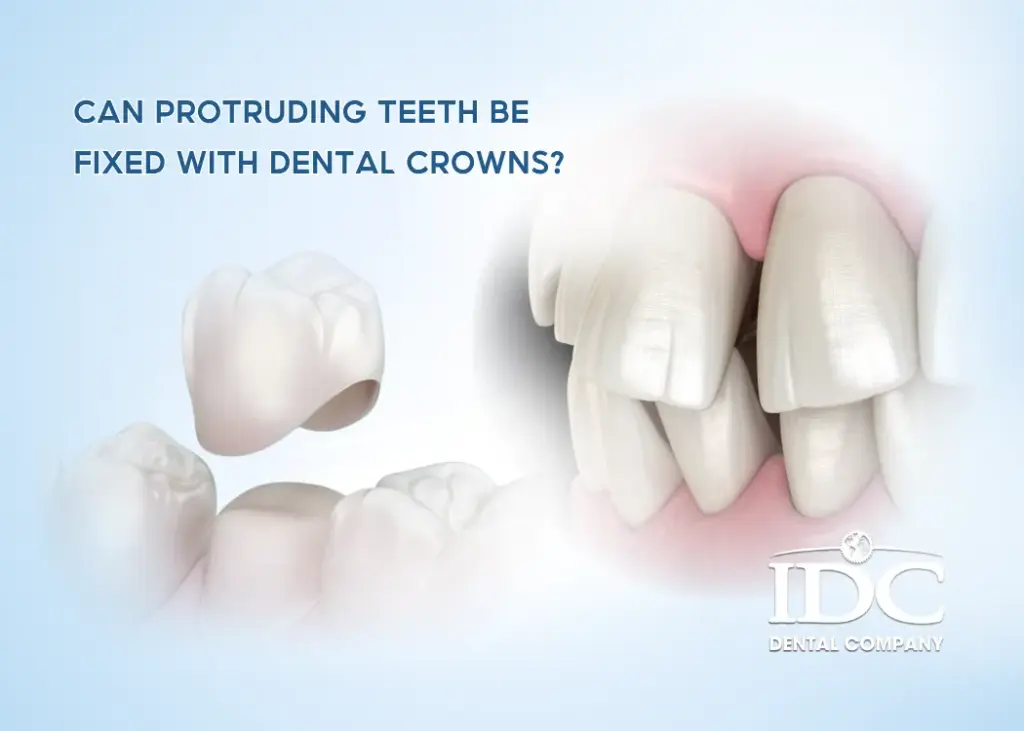
Understanding why the teeth protrude is therefore an important first step before choosing between dental crowns, veneers, or orthodontic treatment.
What Are Protruding Teeth?
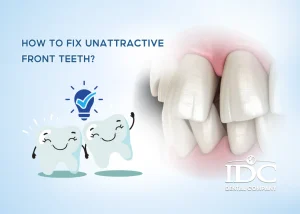
Protruding teeth are teeth that extend or angle forward more than expected in relation to the surrounding teeth, lips, or jaws. The upper front teeth are most commonly affected.
Some people have only slightly prominent front teeth, while others have significant protrusion that can affect the appearance of the smile, facial profile, lip closure, and bite.
Common signs include:
- Upper front teeth that appear to stick out
- Front teeth angled forward
- A noticeable horizontal distance between the upper and lower front teeth
- Difficulty closing the lips comfortably
- Crowding or spacing around the front teeth
- Front teeth that look particularly prominent from the side
The severity of protrusion varies considerably, and determining its cause is essential before choosing treatment.
Are Protruding Teeth the Same as an Overbite?
Not exactly. The terms protruding teeth, overjet, and overbite are often confused.
Overjet describes the horizontal distance between the upper and lower front teeth. When the upper teeth are positioned significantly ahead of the lower teeth, the overjet may be increased.
Overbite describes the vertical overlap of the upper front teeth over the lower front teeth when the mouth is closed.
A person can therefore have protruding front teeth and increased overjet without necessarily having an excessive overbite.
Because these conditions require different approaches, a dental or orthodontic assessment is important before treatment.
What Causes Protruding Front Teeth?
There is no single cause of protruding teeth. The appearance may result from tooth position, jaw structure, available space, habits, or a combination of factors.
Tooth Position
In some cases, the jaws have a relatively normal relationship, but the front teeth themselves are tilted or positioned too far forward.
Mild dental protrusion may primarily affect appearance, while more significant tooth angulation can also influence the bite and lip position.
Jaw Structure
Sometimes the problem is not limited to the teeth.
The upper jaw may be positioned relatively forward, the lower jaw may be positioned farther back, or both conditions may occur together.
In these cases, simply changing the shape of the front teeth cannot correct the underlying skeletal relationship.
Crowding
When there is insufficient space in the dental arch, teeth can rotate, overlap, or tilt outward.
Crowding can therefore contribute to the appearance of protruding front teeth.
Genetics
Jaw size, facial structure, tooth size, and tooth position can all have a genetic component. Some people naturally develop more prominent front teeth because of the relationship between their teeth and jaws.
Childhood Habits
Certain prolonged childhood habits may influence the position of the teeth and development of the jaws.
Examples include:
- Thumb sucking
- Prolonged pacifier use
- Tongue thrusting
The effect varies depending on how frequently and how long the habit continues.
How Do Dentists Evaluate Protruding Teeth?
Before deciding whether crowns can improve protruding teeth, the dentist needs to determine whether the problem comes primarily from the teeth or the jaws.
An examination may include an assessment of:
- Tooth position
- Tooth angulation
- Overjet
- Overbite
- Crowding and spacing
- Jaw relationship
- Facial profile
- Lip position
- Gum health
- Tooth structure
- Existing restorations
- Bite and occlusion
Dental photographs, X-rays, digital scans, and other diagnostic records may also be used when necessary.
This evaluation is particularly important because different treatments accomplish different things.
Dental crowns change tooth shape. Orthodontics changes tooth position.
Neither a crown nor a veneer can reposition the jaw.
Can Protruding Teeth Be Fixed with Dental Crowns?
Dental crowns can sometimes make mildly protruding teeth appear less prominent, but they do not actually straighten the teeth.
A crown is a restoration placed over a prepared natural tooth. Because the restoration can be designed with a different shape and contour, it may be possible to modify the visible appearance of a mildly protruding tooth.
Dental crowns can change:
- Visible tooth shape
- Tooth size
- Tooth color
- Tooth contour
- Tooth proportions
- Apparent tooth angle to a limited degree
However, crowns cannot change:
- Tooth root position
- Jaw position
- Significant tooth angulation
- Severe crowding
- Skeletal protrusion
- Major orthodontic problems
For this reason, crowns should not automatically be considered an alternative to braces or clear aligners.
How Can Crowns Make Protruding Teeth Look Straighter?
To place a dental crown, the natural tooth is prepared to create space for the restorative material. The new crown is then designed to restore the tooth while achieving the desired external shape.
When a tooth protrudes only slightly, its visible contour may sometimes be modified so that it appears better aligned with neighboring teeth.
However, there are limits.
Imagine a tooth that is only slightly tilted forward. A dentist may have enough space to alter its external contour without dramatically changing the underlying tooth.
If the tooth is severely angled forward, creating a crown that appears completely straight could require removing a much greater amount of natural tooth structure.
The greater the difference between the actual tooth position and the desired appearance, the more difficult it becomes to correct the problem safely with restorative dentistry alone.
When Are Dental Crowns Recommended for Protruding Teeth?
Crowns may be considered when there is both a cosmetic concern and a legitimate restorative reason for covering the tooth.
1. Mildly Protruding Teeth
Crowns may provide limited cosmetic correction when the protrusion is minor.
The dentist must determine whether the desired contour can be achieved while preserving sufficient healthy tooth structure.
2. Protruding Teeth With Significant Structural Damage
Crowns may be particularly appropriate when mildly protruding teeth are already damaged.
Examples include:
- Large fractures
- Extensive tooth decay
- Large existing fillings
- Significant loss of tooth structure
- Severely weakened teeth
If a crown is already required to restore the tooth, its shape can sometimes be designed to make the tooth appear less prominent at the same time.
3. Certain Root Canal-Treated Teeth
Some root canal-treated teeth may require crowns depending on the amount and quality of remaining tooth structure.
If such a tooth is mildly protruding, crown design may also improve its visible shape and proportions.
However, having root canal treatment does not automatically mean that every tooth needs a crown.
4. Protrusion Combined With Other Cosmetic Concerns
Crowns may also be considered when mildly protruding teeth have significant additional problems such as:
- Severe discoloration
- Abnormal tooth shape
- Extensive previous restorations
- Significant wear
- Structural defects
A carefully designed crown can potentially address several restorative and cosmetic concerns at the same time.
5. When the Bite Is Suitable
Even when protrusion is mild, the bite must allow adequate space for a properly designed restoration.
A crown needs sufficient thickness for strength while maintaining appropriate contact with the opposing teeth.
When Are Dental Crowns NOT Recommended for Protruding Teeth?
The fact that crowns can change tooth shape does not mean they are appropriate for every protruding tooth.
Moderate to Severe Protrusion
If the teeth extend significantly forward, crowns generally cannot compensate for the entire positional problem without substantial tooth preparation.
In these situations, orthodontic treatment should usually be considered.
Protrusion Caused by Jaw Structure
Crowns cannot move the upper or lower jaw.
If the appearance is primarily caused by the relationship between the jaws, changing the front teeth alone will not correct the underlying skeletal problem.
Healthy Teeth With Significant Misalignment
If the teeth are healthy but positioned incorrectly, removing healthy tooth structure to place crowns may not be the most conservative approach.
Orthodontics can often reposition natural teeth without requiring full-coverage restorations.
Severe Crowding
Crowns cannot create the space needed to properly align several crowded teeth.
Trying to disguise severe crowding with restorations may produce bulky or unnatural tooth shapes and require excessive preparation.
Significant Bite Problems
Protrusion may occur together with an increased overjet, deep bite, open bite, or another occlusal problem.
Changing the visible shape of the teeth does not necessarily correct these underlying bite relationships.
When Excessive Tooth Reduction Would Be Required
This is one of the most important reasons not to use crowns for significant protrusion.
If creating the desired appearance requires removing a large amount of healthy tooth structure, orthodontic or other treatment options should be considered.
Active Tooth Decay or Gum Disease
Active oral health problems should be treated before elective cosmetic restorative procedures.
What Are the Risks of Using Crowns to Correct Severe Protrusion?
Dental crowns are well-established restorative treatments, but attempting to use them to disguise a large positional problem can create unnecessary challenges.
Potential concerns include:
- Excessive removal of healthy tooth structure
- Increased risk of irritation to the dental pulp
- Unfavorable crown thickness
- Bite interference
- Unnatural tooth proportions
- Bulky or over-contoured restorations
- Increased stress on the restored teeth
The more dramatic the attempted change in apparent tooth position, the more carefully these biological and restorative limits need to be considered.
This is why a conservative treatment plan should focus not only on achieving a fast cosmetic result but also on maintaining long-term tooth health.
Do Teeth Need to Be Shaved for Dental Crowns?
Yes. Dental crowns generally require preparation of the natural tooth.
The dentist reduces and reshapes the tooth to:
- Create space for the restorative material
- Provide adequate crown thickness
- Allow proper fit
- Establish appropriate contours
- Maintain a functional bite
The amount of preparation varies according to the crown material, tooth condition, existing restorations, tooth position, bite, and desired result.
For protruding teeth, preparation becomes especially important because a significant change in apparent tooth angle may require more tooth reduction.
Do You Need a Root Canal Before Getting Crowns on Protruding Teeth?
Not necessarily.
Root canal treatment is not routinely required before placing a dental crown.
It should only be performed when there is an appropriate clinical reason, such as irreversible inflammation, infection, or significant damage to the dental pulp.
However, aggressive preparation of a severely protruding tooth can increase the risk of affecting the pulp.
This is another reason why healthy, significantly protruding teeth should be carefully evaluated before crowns are considered.
Crowns vs Orthodontics for Protruding Teeth
One of the most important decisions is whether to change the shape of the teeth or their actual position.
| Feature | Dental Crowns | Orthodontics |
|---|---|---|
| Changes tooth shape | Yes | No |
| Changes tooth color | Yes | No |
| Moves tooth roots | No | Yes |
| Improves crowding | Limited | Yes, depending on case |
| Requires tooth preparation | Yes | Generally no |
| Restores damaged teeth | Yes | No |
| Suitable for significant protrusion | Limited | Often more appropriate |
| Treatment duration | Usually shorter | Usually longer |
If the teeth are structurally damaged and protrusion is minor, crowns may make sense.
If healthy teeth are significantly protruding because of their position, orthodontics may be a more conservative approach.
Can Braces Fix Protruding Teeth?
Yes, braces are commonly used to manage protruding and misaligned teeth.
Unlike crowns, braces gradually apply controlled forces to move the teeth and their roots.
They may be useful when protrusion occurs together with:
- Crowding
- Rotated teeth
- Spacing
- Increased overjet
- Multiple alignment problems
- Certain bite abnormalities
Depending on the amount of available space and the complexity of the case, additional orthodontic strategies may be required.
Can Clear Aligners Fix Protruding Teeth?
Clear aligners may also be suitable for selected patients.
Depending on the case, aligners may help:
- Reposition front teeth
- Improve alignment
- Retract selected teeth
- Manage spacing
- Improve certain bite relationships
However, clear aligners are not automatically suitable for every case of protrusion.
The amount of tooth movement required, available space, root position, bite, and complexity of the case all need to be evaluated.
Can Veneers Fix Protruding Teeth?
Porcelain veneers can sometimes improve the appearance of very mildly protruding teeth, particularly when there are additional concerns involving tooth color, size, or shape.
However, veneers have the same fundamental limitation as crowns: they do not move the tooth roots.
Veneers may be considered when:
- Protrusion is very mild
- Tooth position is otherwise acceptable
- The bite is suitable
- The patient also wants to improve tooth color or shape
They may not be appropriate when:
- Teeth protrude significantly
- There is substantial crowding
- Large positional changes are required
- Significant bite problems are present
For healthy teeth with moderate or severe protrusion, orthodontic treatment should generally be evaluated before restorative alternatives.
Crowns vs Veneers for Protruding Front Teeth
Both crowns and veneers can modify the visible shape of front teeth, but they differ considerably in how much tooth structure they cover.
Veneers primarily cover the visible front surface of the tooth and generally require less preparation than crowns in suitable cases.
Crowns cover most or all of the visible clinical tooth and typically require greater tooth preparation.
Veneers may be considered when the teeth are relatively healthy and the cosmetic correction required is limited.
Crowns are generally more appropriate when the teeth already have significant structural damage or require full coverage.
Neither treatment actually moves the teeth.
Therefore, when the primary problem is tooth position rather than tooth shape or structure, orthodontics should be considered.
Can Protruding Teeth Be Fixed Without Braces?
Yes, in some cases, but “without braces” does not necessarily mean using crowns.
Clear aligners may provide an orthodontic alternative for suitable patients.
For very mild cosmetic irregularities, options such as composite bonding, veneers, or crowns may sometimes alter the visible appearance.
However, restorative treatments should not be viewed as a universal shortcut to orthodontics.
If healthy teeth are significantly protruding, physically moving them may preserve more natural tooth structure than aggressively reshaping them.
What Is the Best Treatment for Mildly Protruding Teeth?
The best treatment depends on tooth health and the reason for the protrusion.
If the teeth are healthy and the primary concern is position, orthodontics or clear aligners may be appropriate.
If the protrusion is very mild and the main concern involves tooth shape, bonding or veneers may sometimes be considered.
If a mildly protruding tooth is already heavily restored, fractured, or structurally compromised, a crown may be a reasonable option.
The goal is to choose the least invasive treatment capable of providing a stable and aesthetically acceptable result.
What About Severely Protruding Teeth?
Severe protrusion usually requires a more comprehensive assessment.
The dentist or orthodontist may need to evaluate:
- Tooth angulation
- Root position
- Available space
- Overjet
- Jaw relationship
- Facial profile
- Bite
- Lip position
Orthodontic treatment with braces or clear aligners may be considered depending on the case.
If the protrusion is primarily skeletal, more comprehensive orthodontic treatment and, in selected severe cases, an evaluation for jaw surgery may be necessary.
Crowns alone generally cannot correct severe dental or skeletal protrusion.
Can Crowns on Protruding Front Teeth Look Natural?
When crowns are appropriately indicated, they can be designed to blend naturally with the surrounding teeth.
Creating natural-looking front crowns involves considering:
- Tooth width and length
- Tooth proportions
- Shape
- Color
- Translucency
- Surface texture
- Gum line
- Smile line
- Facial proportions
- Bite
A natural smile does not necessarily mean perfectly identical or extremely white teeth.
If too much positional correction is attempted with crowns, however, the restorations may need unnatural proportions or contours. This is another reason why proper case selection is essential.
How Long Does It Take to Fix Protruding Teeth?
Treatment time depends on the chosen method and complexity of the case.
Dental crowns generally involve several stages, including:
- Examination and diagnosis
- Treatment planning
- Tooth preparation
- Impression or digital scan
- Crown fabrication
- Final placement
Veneers follow a similar restorative process.
Braces and clear aligners usually require more time because the teeth must move gradually.
Although restorative treatment may create a visible cosmetic change more quickly, treatment speed should not be the only consideration.
Preserving healthy teeth and achieving a stable bite are equally important.
How Much Does It Cost to Fix Protruding Teeth?
There is no single cost because treatment can range from restoring one damaged front tooth to comprehensive orthodontic correction.
Cost may depend on:
- Severity of protrusion
- Number of teeth involved
- Condition of the teeth
- Treatment method
- Crown or veneer material
- Orthodontic complexity
- Additional dental treatment
- Location and dental provider
For example, treating two mildly protruding and heavily damaged teeth with crowns is very different from orthodontically repositioning an entire dental arch.
A clinical examination is necessary before an accurate treatment plan and cost estimate can be provided.
How Does a Dentist Choose Between Crowns, Veneers, and Orthodontics?
Several questions can help guide treatment.
Are the Natural Teeth Healthy?
If they are healthy, preserving tooth structure should be a priority.
Is the Main Problem Tooth Position?
If the teeth are positioned incorrectly, orthodontics should be considered because it actually moves them.
How Severe Is the Protrusion?
Very mild protrusion may sometimes allow limited cosmetic modification. Moderate or severe protrusion is less suitable for restorative correction alone.
Are the Teeth Already Damaged?
If significant structural damage is present, crowns may be more appropriate because the teeth already require restoration.
Is the Problem Related to the Jaw?
If so, crowns and veneers cannot correct the underlying skeletal relationship.
How Much Tooth Structure Would Need to Be Removed?
If excessive reduction would be required, a more conservative alternative should be explored.
Common Mistakes to Avoid When Treating Protruding Teeth
Patients considering cosmetic treatment for protruding front teeth should avoid several common misconceptions:
- Assuming crowns actually straighten the teeth
- Choosing crowns simply because they appear faster than orthodontics
- Removing large amounts of healthy tooth structure unnecessarily
- Ignoring tooth root position
- Ignoring the jaw relationship
- Ignoring bite problems
- Using veneers to disguise severe protrusion
- Treating only the visible front teeth without evaluating the entire bite
- Choosing treatment based solely on price
- Skipping orthodontic evaluation when significant misalignment is present
A successful result should balance appearance, function, oral health, and preservation of natural tooth structure.
Frequently Asked Questions
Can Protruding Teeth Be Fixed With Dental Crowns?
Mild protrusion can sometimes be cosmetically improved with dental crowns, especially when the teeth already require restorative treatment. Crowns cannot physically move the teeth or their roots.
Can Crowns Make Protruding Front Teeth Look Straighter?
In selected mild cases, yes. Crown design can change the visible contour and apparent angle of a tooth, but the actual tooth position remains unchanged.
Can Crowns Fix an Overjet?
Crowns cannot correct a significant overjet caused by tooth position or jaw relationship. Orthodontic evaluation is generally required.
Can Crowns Fix an Overbite?
Crowns are not a standard treatment for correcting an underlying overbite. Treatment depends on its cause and severity.
Are Crowns Better Than Braces for Protruding Teeth?
Not generally. If healthy teeth are significantly protruding because of their position, braces or other orthodontic treatment may be more conservative. Crowns may be more suitable when teeth are already structurally damaged and protrusion is mild.
Can Clear Aligners Move Protruding Teeth Back?
In selected cases, yes. Suitability depends on tooth position, available space, bite, and the amount of movement required.
Can Veneers Fix Protruding Front Teeth?
Veneers may improve the appearance of very mild protrusion but cannot move the tooth roots. Significant protrusion usually requires orthodontic assessment.
Do I Need a Root Canal Before Getting Crowns?
No. Root canal treatment is only necessary when clinically indicated and is not automatically required before crown placement.
Can Protruding Teeth Be Fixed Without Braces?
Sometimes. Clear aligners may be an alternative to braces, while selected very mild cosmetic concerns may be managed with bonding, veneers, or crowns. The appropriate option depends on the cause and severity of protrusion.
What Is the Fastest Way to Fix Protruding Front Teeth?
Crowns or veneers may create faster visible changes in selected cases, but the fastest treatment is not necessarily the most appropriate. Healthy tooth preservation, bite, and long-term stability should also be considered.

 WhatsApp